
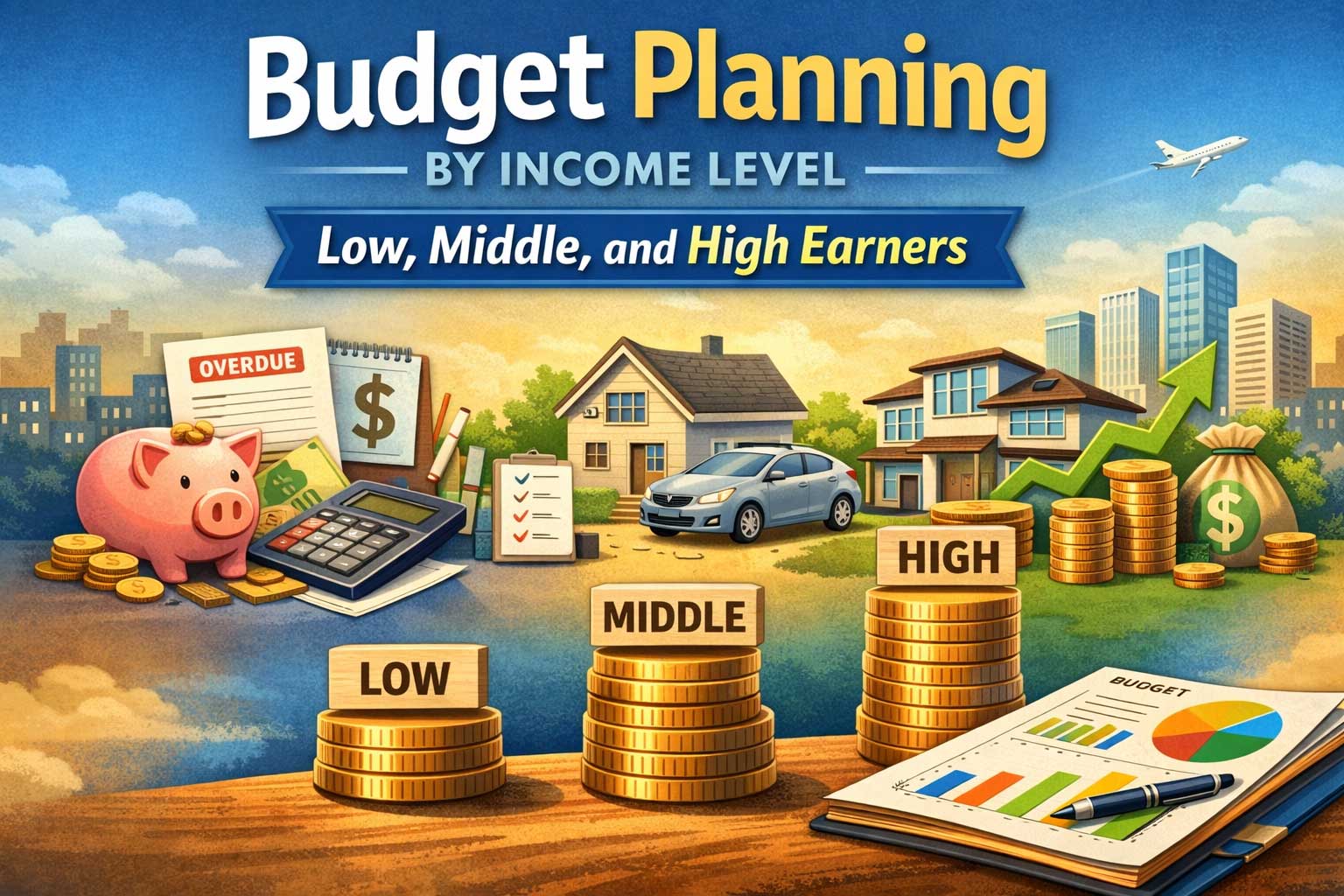
Budget planning is not “one-size-fits-all.” Two people can follow the exact same budgeting method and still get very different results because income level changes the entire game: the size of your margin, the pressure of fixed costs, the speed of debt payoff, the ability to absorb emergencies, the pace of investing, and even the psychology of money decisions.
This guide breaks budget planning into three practical income levels—low, middle, and high earners—not to label anyone, but to match strategies to reality. If your income is tight, budgeting is survival and stability. If your income is moderate, budgeting is about building margin and accelerating progress. If your income is high, budgeting is about preventing lifestyle inflation and turning cash flow into long-term wealth.
You’ll get a full system for each level: priorities, percentage frameworks, common traps, step-by-step planning, examples, and a simple process you can repeat every month.
The Core Truth: Your Budget Is a Strategy, Not a Spreadsheet
Many people treat a budget like a list of restrictions. But the best budgets are strategies that answer three questions:
- What must be protected first? (housing, food, utilities, basic transportation, health, minimum debt payments)
- What creates future freedom? (emergency fund, debt payoff, skill-building, investing)
- What makes life enjoyable without breaking the plan? (fun money, travel, hobbies, giving)
Your income level determines how difficult it is to cover the first category and how quickly you can fund the second. That’s why budget planning must change with income level.
Step Zero for Everyone: Know Your Real Monthly Income
Before you can budget, you need the number you can safely plan around.
If you have a fixed salary
Use your net pay (after taxes and deductions). If you get bonuses or overtime, only budget them after you actually receive them, or use a conservative average.
If you have irregular income (freelance, commission, business)
Use one of these approaches:
- Lowest-month method (safe): Use the lowest month from the last 6–12 months as your baseline.
- Average-minus method (balanced): Average last 6–12 months, then subtract 10–20% for safety.
- Two-tier method (smart):
- Tier 1: Baseline income (consistent minimum)
- Tier 2: Extra income (variable) gets assigned rules: emergency fund, debt payoff, investing, taxes, business reserves.
A budget fails when it’s built on a fantasy income number. A budget works when it’s built on a conservative, repeatable income number.
Step One for Everyone: Identify Your “Budget Type” (Tight, Balanced, Abundant)
Instead of guessing your income level by salary alone, use a more accurate measure:
Your Margin Rate
Margin Rate = (Income − Essential Costs) ÷ Income
- Essential costs include: housing, basic food, utilities, basic transportation, minimum debt payments, insurance, required medical, essential childcare.
- Exclude optional spending like dining out, subscriptions, shopping, travel upgrades.
Why this matters: Two people can earn the same income, but one has high rent and loans (low margin), while another has low rent and no debt (high margin). Their budget strategy must differ.
- Tight budget: Margin rate under ~15%
- Balanced budget: Margin rate around ~15%–35%
- Abundant budget: Margin rate above ~35%
This margin rate will usually align with low/middle/high earners, but it’s more practical because it matches your real-life flexibility.
Step Two for Everyone: Use “Priority Buckets” Instead of Random Categories
A budget works best when it has clear priority order. Use these buckets in order:
- Essentials (Keep life running)
- Stability (Avoid chaos)
- Progress (Move forward)
- Lifestyle (Enjoy life responsibly)
- Wealth (Build long-term freedom)
Low earners focus heavily on 1 and 2. Middle earners build 2 and accelerate 3. High earners must defend 5 from lifestyle inflation.
Budget Planning for Low Earners: Stability First, Progress Second
A “low earner budget” usually has one defining feature: limited margin. When margin is limited, small surprises become big disasters. The budget’s main job is to protect you from the most common financial emergencies while creating a path toward higher income and stronger stability.
The Goal of Budgeting at a Low Income
- Stay current on essentials
- Prevent emergencies from becoming debt
- Build a starter emergency fund
- Reduce high-interest debt
- Increase earning power over time
This is not about perfection. It’s about building a system that reduces stress and increases control.
A Strong Low-Income Budget Framework
When income is tight, strict “percentage rules” can feel unrealistic because essentials can exceed the recommended range. So instead of forcing a perfect split, use a “priority-first” framework:
Priority-First Low-Income Allocation (example)
- Essentials: As low as realistically possible (often 65%–85%+)
- Stability fund: 5%–10% until you reach a starter emergency fund
- Debt minimums: Required minimums (then extra only after stability is started)
- Progress: 5%–10% (skills, tools, transport reliability, job search costs)
- Lifestyle: 0%–5% (small controlled amount to prevent burnout)
If your essentials take nearly all your income, the budget is still successful if it keeps you stable and avoids new debt.
The Low-Income Budgeting Method That Works Best: “Minimums + Buffers + Targets”
Instead of trying to budget every single dollar perfectly, use this structure:
- Minimums: What absolutely must be paid to avoid damage (rent, electricity, basic food, transport to work, minimum debt payments).
- Buffers: Small amounts set aside for the most likely problems (medical, repairs, fees).
- Targets: The next milestones (starter emergency fund, debt payoff, skills).
This method prevents the most common failure: a budget that collapses the moment something unexpected happens.
Step-by-Step Low-Income Budget Setup
Step 1: Build a “Bare-Bones Essentials List”
Make a list of the minimum you need for:
- Housing (rent/mortgage)
- Utilities (electricity, water, phone, internet if needed for work)
- Basic groceries
- Transportation (fuel, transit pass, basic maintenance)
- Insurance (health, auto if required)
- Minimum debt payments
- Childcare needed to work
Now add them up. If they exceed your income, your budget strategy becomes triage: reduce what can be reduced, negotiate, seek assistance, restructure debt, and prioritize income growth.
Step 2: Choose a Starter Emergency Fund Amount
For low income, start with a realistic number:
- Starter goal: 1–2 weeks of essentials
- Next goal: one month of essentials
- Longer-term: 3 months of essentials
Your starter fund is not a “wealth” move; it is a stress reduction tool. It reduces overdrafts, late fees, payday loans, and credit card dependence.
Step 3: Create a “Bill Calendar” Budget
If cash flow timing is a problem, budgeting by month alone doesn’t work. Use a bill calendar:
- List pay dates
- List due dates
- Assign each bill to the paycheck that will pay it
This prevents late fees and panic spending.
Step 4: Use Cash or Separate Wallets for Variable Spending
Low income budgets fail most often in variable categories:
- food
- transport
- personal spending
Use one of these:
- cash envelopes (physical or digital)
- separate spending account
- weekly spending limits
Weekly limits feel easier than monthly limits because they match real decision-making.
Common Low-Income Traps and How to Beat Them
Trap 1: Trying to cut essentials forever
There is a limit to how much you can cut. The long-term solution is usually a combination of:
- reducing the biggest fixed cost (housing/transport)
- improving income
- eliminating high-interest debt
A low-income budget must include an “income plan,” not only a spending plan.
Trap 2: Ignoring small fees and “money leaks”
Low income budgets are highly sensitive. Small fees can be huge:
- overdraft charges
- late fees
- delivery fees
- buy-now-pay-later fees
A stability fund prevents these.
Trap 3: Emotional spending from stress
When money is tight, the brain looks for relief. If you don’t plan some relief, you will usually buy relief.
Even $10–$20 set aside weekly for controlled enjoyment can prevent a bigger blow-up.
Low-Income Example Budget (Illustrative)
Assume monthly net income: 1,000 (currency units)
- Essentials: 780
- Stability fund: 70
- Minimum debt payments: 80
- Progress (skills/tools/job costs): 40
- Lifestyle buffer: 30
This is not glamorous. But it creates:
- bills paid
- emergency buffer growing
- debt staying under control
- small progress toward higher income
The Most Powerful “Wealth Strategy” for Low Earners: Raise Income Without Raising Lifestyle
If your income increases, your budget should not immediately expand lifestyle. The most important moment in your financial life is when you get a raise or new income stream. If you keep lifestyle stable for 6–12 months and route the difference to stability and debt, you can change your life fast.
Low earners should focus on a simple rule:
Every new income increase is assigned 50% to stability/progress and only 50% to lifestyle upgrades until you are stable.
Budget Planning for Middle Earners: Build Margin, Then Accelerate Wealth
Middle income budgets often have enough flexibility to cover essentials and still have some room. But the biggest challenge here is that money can disappear silently. Lifestyle inflation grows slowly: nicer groceries, more subscriptions, more dining out, better phone plans, random upgrades. Nothing feels huge, but progress slows.
The Goal of Budgeting at a Middle Income
- Build a real emergency fund (3–6 months)
- Pay off expensive debt
- Invest consistently
- Upgrade lifestyle intentionally
- Protect progress from lifestyle inflation
Middle earners are in the “power zone.” Small decisions compound quickly—either toward wealth or toward staying stuck.
A Strong Middle-Income Budget Framework: The “Stability + Growth Split”
For middle income, percentages become more usable. Here are two practical frameworks:
Framework A: Balanced Growth (great for most people)
- Essentials: 50%–60%
- Financial goals (debt payoff + savings + investing): 20%–30%
- Lifestyle: 15%–25%
Framework B: Aggressive Wealth Building (if you want speed)
- Essentials: 45%–55%
- Financial goals: 30%–40%
- Lifestyle: 10%–20%
Notice what changes from low income: financial goals become a major category, not a leftover.
Step-by-Step Middle-Income Budget Setup
Step 1: Automate your “Financial Goals” first
Middle earners often succeed when they treat savings and investing like bills.
Automate:
- emergency fund contribution
- retirement/investing contribution
- debt extra payments (if applicable)
Automation prevents “I’ll save what’s left” (which usually becomes “I saved nothing”).
Step 2: Use a “Fixed vs Flexible” structure
Split categories into:
- Fixed: rent/mortgage, insurance, loan payments, subscriptions, childcare, phone plan
- Flexible: groceries, dining, fuel, entertainment, shopping, personal care
Then set a hard limit for flexible spending. Many middle earners overspend because they don’t have a clear flexible ceiling.
Step 3: Create a “Sinking Funds” system
Sinking funds stop predictable expenses from becoming emergencies:
- car repairs
- medical
- holidays
- travel
- annual fees
- home maintenance
- gifts
This is the secret weapon that makes your budget feel easy.
Step 4: Add a “Lifestyle Allowance” with rules
Rather than tracking every coffee, set a monthly lifestyle allowance for guilt-free spending.
Rules:
- once it’s spent, stop
- no borrowing from next month
- if you want something bigger, save for it
This prevents both overspending and burnout.
Middle-Income Trap: The Subscription + Convenience Budget Leak
At middle income, the most common hidden leak is convenience spending:
- food delivery
- rideshares instead of planned transport
- upgrades on everything
- multiple subscriptions that aren’t used
A practical fix: once per month, review recurring costs and ask:
- “Do I use this weekly?”
- “Does this reduce stress more than it costs?”
- “Is there a cheaper plan that gives 80% of the benefit?”
Cutting one or two recurring costs can free up meaningful monthly cash flow without feeling like deprivation.
Middle-Income Debt Strategy: Attack High-Interest First, Then Build Wealth
If you have high-interest debt, your plan should usually prioritize:
- Minimums on all debts
- Extra payments on the highest interest rate debt
- Build emergency fund to at least one month (so you don’t go back into debt)
- Then accelerate debt payoff + investing
For many middle earners, the best balance is:
- emergency fund grows steadily
- debt payoff is aggressive but not so aggressive you break the budget
Consistency beats intensity.
Middle-Income Investing Strategy: Start Simple, Stay Consistent
You don’t need complex investing to build wealth. Most middle-income success comes from:
- consistent contributions
- long time horizon
- avoiding panic decisions
- increasing contributions as income rises
A budget that invests every month—even modestly—creates identity shift: you become the kind of person who builds wealth.
Middle-Income Example Budget (Illustrative)
Monthly net income: 3,000
- Essentials: 1,650 (55%)
- Financial goals: 900 (30%)
- Emergency fund: 300
- Investing: 400
- Debt extra: 200
- Lifestyle: 450 (15%)
This budget:
- builds stability
- reduces debt
- invests consistently
- still leaves room to enjoy life
The “Middle Earner Wealth Accelerator”: Keep fixed costs from rising with income
The most powerful middle-income rule:
When your income increases, keep your fixed costs stable.
Why? Fixed costs are hard to reduce. If you upgrade your rent, car payment, and subscriptions every time you earn more, you trap yourself at the same margin forever.
A smarter rule:
- Allow lifestyle upgrades, but put a cap on fixed-cost growth.
- Make upgrades mostly flexible (occasional travel, nicer experiences) instead of permanent obligations.
Budget Planning for High Earners: Defend Wealth from Lifestyle Inflation and Complexity
High earners often have a different problem: they can pay for almost anything, so they feel like they don’t need a budget. But high income without a plan can still produce:
- high debt
- low savings rate
- financial stress from obligations
- poor investing discipline
- “invisible” spending that prevents wealth growth
At high income, the budget is less about constraint and more about:
- allocation
- protection
- optimization
- intentional lifestyle design
The Goal of Budgeting at a High Income
- Maintain a high savings/investing rate
- Prevent lifestyle inflation from consuming raises
- Use tax-smart and goal-driven planning
- Create a plan for big goals (home, business, family, freedom)
- Build wealth that matches income level
High income is an opportunity, but it doesn’t automatically become wealth.
A Strong High-Income Budget Framework: “Pay Yourself First at a High Rate”
If you earn a lot, your best advantage is a high savings rate. Many high earners can realistically target:
- Essentials: 30%–45%
- Lifestyle: 20%–35%
- Wealth building (investing, savings, giving, goal funds): 25%–50%
This is broad because high earners vary: some have high taxes, expensive cities, large family costs, or business expenses. But the key idea is consistent: wealth building should be a major slice, not an afterthought.
Step-by-Step High-Income Budget Setup
Step 1: Define your “Wealth Floor”
A wealth floor is the minimum you commit to investing/saving every month, no matter what. It might be:
- 25% of net income
- a fixed amount
- a fixed amount plus all bonuses
This floor keeps lifestyle inflation from quietly eating everything.
Step 2: Use “Lifestyle Tiers” instead of unlimited spending
High earners often overspend because spending is unbounded. Create tiers:
- Tier 1 Lifestyle: basic enjoyment (restaurants, hobbies, small travel)
- Tier 2 Lifestyle: luxury upgrades (premium travel, designer goods, high-end services)
- Tier 3 Lifestyle: major commitments (expensive car payments, expensive housing upgrades, long-term recurring luxury expenses)
A good budget limits Tier 3 strongly. Tier 3 is where people get trapped. Tier 1 and Tier 2 can be enjoyed when the wealth floor is met.
Step 3: Build advanced sinking funds for big goals
High earners often have big goals that require planning:
- down payment
- business investment
- private school/education
- family support
- home renovations
- travel plans
- future sabbatical
- large tax payments (especially for variable income)
Sinking funds turn big goals into manageable monthly allocations.
Step 4: Control “Obligation Creep”
As income rises, obligations grow:
- helping family
- social commitments
- memberships
- subscription bundles
- expensive habits
Build a category called Obligations & Giving with a clear limit. This allows generosity without financial chaos.
High-Income Trap: High Expenses That Feel “Normal”
At high income, expensive things can feel normal:
- dining out frequently
- premium delivery services
- upgrading electronics often
- luxury car payments
- expensive housing upgrades
- constant travel
None of these are “wrong.” The trap is when they become default and automatic rather than intentional and aligned with long-term goals.
The budget is what keeps you honest:
- Are you buying freedom later or comfort now?
- Are you building assets or accumulating expensive routines?
- Is your lifestyle supporting your life or controlling it?
High-Income Example Budget (Illustrative)
Monthly net income: 10,000
- Essentials: 3,800 (38%)
- Lifestyle: 2,700 (27%)
- Wealth building: 3,500 (35%)
- Investing: 2,500
- Goal funds: 700
- Giving: 300
This can still be adjusted depending on your goals. If you want early financial independence, you might push wealth building to 45%–55%. If you’re in a high-cost city with large family expenses, essentials could be higher. The point is: the wealth building category is always deliberate.
The High Earner Wealth Multiplier: Use “Bonus Rules”
High earners often have bonuses, variable income, or business profits. Without rules, bonuses disappear. With rules, bonuses build wealth fast.
Example bonus rule:
- 50% investing
- 25% taxes/reserves (if needed)
- 15% goal funds (home/business)
- 10% lifestyle reward
This keeps lifestyle enjoyable while still turning high income into assets.
The Most Important Skills by Income Level
Low Earners: Budgeting Skill = Control and Stability
- bill calendar
- starter emergency fund
- variable spending limits
- income growth plan
Middle Earners: Budgeting Skill = Consistency and Margin Growth
- automation
- sinking funds
- controlling fixed costs
- regular reviews
High Earners: Budgeting Skill = Allocation and Lifestyle Design
- wealth floor
- bonus rules
- obligation limits
- goal-based funding
How to Choose the Right Budgeting Method for Your Income Level
Different methods fit different realities.
Best methods for low earners
- Zero-based budgeting (every dollar assigned) if you have the time and want control
- Envelope/weekly spending limits for variable categories
- Bill calendar budgeting to avoid late fees
- Priority-first budgeting when essentials dominate
Best methods for middle earners
- Zero-based budgeting with automation
- 50/30/20 variations (like 55/25/20 or 50/20/30)
- Sinking fund system (game-changer)
- “Pay yourself first” with lifestyle allowance
Best methods for high earners
- Pay yourself first with a wealth floor
- Goal-based budgeting (multiple sinking funds)
- Tiered lifestyle design
- Annual planning + monthly tracking
Building a Budget That Adapts as Your Income Changes
Many people redo budgets from scratch every time income changes. A better approach is a scalable system:
Use a “Base Budget” plus “Growth Rules”
- Base budget covers essentials and minimum goals.
- Growth rules tell every extra dollar where to go.
Example growth rules:
- first, strengthen emergency fund until 3–6 months
- then, pay down high-interest debt
- then, increase investing rate
- then, upgrade lifestyle intentionally
- finally, fund big goals
This makes budgeting feel like progress instead of punishment.
A Complete Monthly Budget Routine (Works for Any Income)
A budget succeeds when it becomes a routine.
Weekly (10 minutes)
- Check spending in variable categories
- Make small adjustments before the month is over
Monthly (45–90 minutes)
- Review last month (what worked, what didn’t)
- Confirm income amount for this month
- List fixed bills and due dates
- Set variable spending limits
- Fund sinking funds
- Assign extra money to priorities
- Automate transfers if possible
Quarterly (1–2 hours)
- Review recurring subscriptions
- Review insurance and major bills
- Review debt payoff progress
- Review investing contributions
- Adjust goals based on life changes
This routine keeps your budget alive and realistic.
How to Handle Real-Life Problems That Break Budgets
Problem: Unexpected expense
Solution:
- low earners: use stability fund, adjust variable spending, avoid new debt if possible
- middle earners: use sinking funds or emergency fund, then rebuild systematically
- high earners: use dedicated reserves or sinking funds, protect investing floor
Problem: Income drops
Solution:
- immediately switch to bare-bones essentials mode
- pause nonessential sinking funds
- renegotiate bills and reduce fixed costs
- focus on cash flow and stability first
Problem: Overspending repeatedly
Solution:
- don’t just blame discipline; redesign the system
Try: - lowering variable limits and using weekly caps
- creating a fun allowance
- removing spending triggers (saved cards, apps, frequent browsing)
- using a 24-hour rule for nonessential purchases
Budget Planning as a Wealth Strategy: The Real Difference Between Earners Who Build Wealth and Those Who Don’t
Across all income levels, the pattern is simple:
- People who build wealth protect margin.
- People who don’t build wealth let lifestyle expand to consume margin.
The budget is the tool that protects margin.
The 3 Wealth Levers
- Savings rate (how much you keep)
- Time (how long your money grows)
- Behavior consistency (how stable your habits are)
Income helps, but it’s not the only driver. The budget connects income to wealth levers.
Practical Templates You Can Copy (By Income Level)
Low Earners Template (Priority-First)
- Essentials: ____
- Minimum debt: ____
- Stability fund: ____
- Progress fund (skills/tools): ____
- Lifestyle buffer: ____
- Total = Income
Middle Earners Template (Balanced Growth)
- Essentials: 50%–60%
- Investing: 10%–20%
- Emergency + sinking funds: 5%–15%
- Debt extra: 0%–10%
- Lifestyle: 15%–25%
High Earners Template (Wealth Floor)
- Wealth floor investing: ____ (minimum monthly)
- Goal sinking funds: ____
- Essentials cap: ____
- Lifestyle tiers: ____
- Giving/obligations: ____
- Total = Income
Frequently Asked Questions
How do I know if I’m a low, middle, or high earner for budgeting purposes?
Use your margin rate. If you can’t consistently save at least 10% without missing essentials, you’re in the tight-budget zone. If you can save 15%–30% with discipline, you’re in the middle zone. If you can save 30%+ consistently, you’re in the abundant zone.
What if my income is low but my essentials are also low?
Then your strategy may look more like a middle-income plan. Income level matters, but margin matters more.
Should low earners invest or focus on emergency savings first?
A small starter emergency fund usually comes first, because it prevents new debt. After that, a mix of debt payoff and modest investing can work—especially if you have any employer match or strong reason to start early. But stability is usually the foundation.
What’s the biggest budget mistake middle earners make?
Letting fixed costs creep up (bigger rent, higher car payment, more subscriptions) until the margin disappears. Middle earners should protect margin and automate goals.
What’s the biggest budget mistake high earners make?
Not having a clear wealth floor and letting lifestyle become automatic. High earners often spend on convenience and status without realizing how much it costs long-term.
How can I stay motivated if budgeting feels stressful?
Make the budget more humane:
- include a small lifestyle allowance
- focus on progress milestones
- track wins (debt reduced, savings built, investing streak)
A budget should reduce stress, not increase it.
Conclusion: Budget Planning Should Match Your Reality
Budget planning by income level is not about judgment. It’s about matching the tool to the job:
- Low earners need a budget that protects stability and builds a path upward.
- Middle earners need a budget that grows margin, controls fixed costs, and accelerates wealth.
- High earners need a budget that defends their savings rate, prevents obligation creep, and turns strong cash flow into long-term assets.
No matter your income, the best budget is the one you can repeat. A budget is not a one-time event—it’s a monthly rhythm that turns money from stress into strategy, and strategy into wealth over time.