
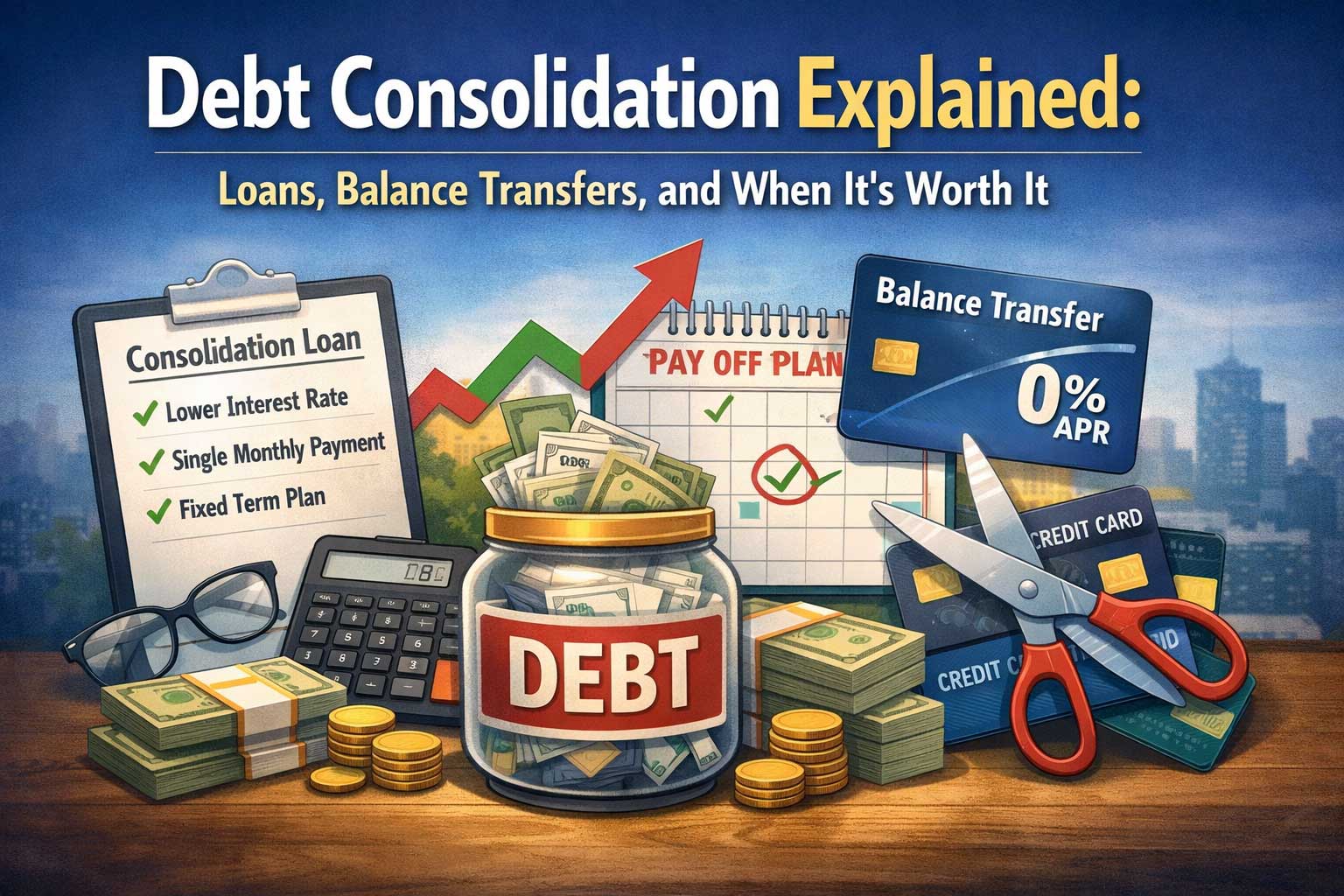
Debt consolidation is one of those financial strategies that can be either a turning point or a trap, depending on how you use it. At its best, consolidation simplifies your finances, lowers your interest cost, and gives you a clear timeline to become debt-free. At its worst, it becomes a temporary “reset button” that makes debt feel smaller while quietly making it more expensive, longer-lasting, and harder to escape.
This guide breaks down debt consolidation in a practical, detailed way. You’ll learn what consolidation really is (and what it is not), how consolidation loans and balance transfers work, how to evaluate the real cost, and the exact situations where consolidation is worth it. You’ll also learn the common mistakes people make—especially the ones that look like “smart money moves” on the surface—plus safer alternatives when consolidation isn’t the right tool.
What Debt Consolidation Actually Means
Debt consolidation means combining multiple debts into one new debt, ideally with a lower interest rate, a simpler payment structure, or both. Instead of making five payments to five creditors, you make one payment to one lender.
That’s the surface definition. But consolidation isn’t automatically a solution. It’s a structure change. You’re rearranging how the debt is packaged and repaid. Whether that structure change helps depends on three things:
- The interest rate and fees on the new debt
- The repayment timeline
- Your behavior and spending habits after consolidation
If consolidation reduces your interest cost and gives you a clear payoff plan you can stick to, it can be powerful. If it merely lowers your monthly payment by stretching debt longer, you may pay more overall even though the payment feels easier.
Consolidation vs. Debt Relief vs. Debt Settlement
People often confuse these terms:
- Debt consolidation: You take new financing (a loan or credit line) to pay off existing debts, leaving you with one new debt. You still repay the full amount you borrowed.
- Debt management plan (DMP): Often arranged through a credit counseling organization. You repay debts through a structured plan and may receive reduced interest rates from creditors.
- Debt settlement: You negotiate to pay less than you owe, typically after falling behind. This can damage credit and may create tax consequences in some jurisdictions.
- Bankruptcy: A legal process that can discharge or reorganize debts. High impact, but sometimes the best clean break.
This article focuses on consolidation loans and balance transfers, plus how to decide when they’re worth it.
Why Debt Consolidation Feels So Attractive
Debt feels heavy because it’s mentally messy. Multiple due dates, different interest rates, confusing minimum payments, penalties, and constant anxiety. Consolidation promises clarity: one payment, one plan, one finish line.
But the psychological relief can be dangerous if it distracts you from the math. Many people consolidate, feel immediate relief, then slowly rebuild balances on the cards they paid off. That creates a double problem: the consolidation debt plus new credit card debt.
So the first rule is simple:
Debt consolidation works best when it comes with a commitment to stop adding new debt.
That might include:
- A strict budget and tracking system
- Pausing credit card use temporarily
- Building a small emergency buffer
- Cutting spending categories that trigger overspending
- Setting clear payoff goals and milestones
Consolidation is not a substitute for a plan. It’s a tool that supports a plan.
The Core Benefits of Debt Consolidation (When Done Right)
If consolidation is done correctly, it can deliver several meaningful benefits:
1) Lower Interest Costs
This is the biggest financial advantage. Credit card APRs can be high, and reducing your rate can shift your payment from mostly interest to mostly principal.
2) One Payment and One Due Date
Fewer moving parts reduces missed payments and late fees. It also makes budgeting easier because your debt payment becomes a single line item.
3) A Clear Payoff Timeline
A structured loan term (like 36 or 60 months) provides a built-in finish line—assuming you don’t extend or refinance repeatedly.
4) Potential Credit Score Support Over Time
Paying down revolving credit card balances can improve credit utilization, which can help credit scores. However, the outcome depends on how your accounts are managed after consolidation.
5) Lower Monthly Payment (Sometimes)
Lower monthly payments can help cash flow, but this benefit is double-edged. A lower payment can be helpful if it prevents missed payments and gives you breathing room. But if it’s achieved by stretching the debt longer, it may increase total cost.
The Risks and Downsides of Debt Consolidation
Consolidation can backfire in predictable ways:
1) You Pay More Over Time
If you reduce the monthly payment mainly by extending the repayment term, your total interest cost can rise even with a lower rate.
2) Fees Can Erase the Savings
Loan origination fees, balance transfer fees, annual fees, and closing costs can reduce or eliminate the benefit.
3) It Can Enable Overspending
The most common consolidation failure is charging credit cards again after they’re paid off. This is how people end up with more debt than before.
4) It May Require Good Credit
The best consolidation options often require decent or strong credit. If your credit is already strained, the offers you receive might not improve your situation.
5) Some Types of Consolidation Put Assets at Risk
A secured consolidation option—like using home equity—can lower the rate, but it may put your home on the line if you can’t repay.
Debt Consolidation Options: An Overview
Debt consolidation can happen through several methods:
- Debt consolidation loan (personal loan)
- Balance transfer credit card (0% promotional APR)
- Home equity loan or home equity line of credit (HELOC)
- 401(k) loan (where applicable)
- Debt management plan (not a loan, but a consolidation-style repayment structure)
- Refinancing or restructuring existing debt (sometimes for student loans or auto loans)
This guide focuses mainly on personal loans and balance transfers, because those are the most common consumer consolidation routes for credit card debt and unsecured debts.
Debt Consolidation Loans: How They Work
A debt consolidation loan is usually an unsecured personal loan. You borrow a lump sum and use it to pay off multiple debts. Then you repay the loan in fixed monthly payments over a fixed term.
Key Features
- Fixed interest rate (often, though some are variable)
- Fixed payment
- Term length commonly 2 to 7 years
- Single payoff schedule
How the Process Usually Works
- You apply for a personal loan.
- You receive an offer: loan amount, interest rate, term, and fees.
- You accept and receive funds (sometimes paid directly to creditors).
- You pay off your existing debts.
- You make one monthly payment on the loan until it’s repaid.
The True Goal of a Consolidation Loan
The goal is not simply to reduce your payment. The goal is to reduce interest and speed up payoff while keeping payments affordable.
If your loan lowers your payment but extends your timeline significantly, you may feel relief but lose progress.
What Makes a Consolidation Loan “Good”?
A consolidation loan is usually worth considering when the new loan does most of these:
- Lower interest rate than your weighted average interest rate on current debts
- Reasonable fees (or none)
- Term that doesn’t stretch repayment too long
- Monthly payment you can realistically maintain
- You will stop using the paid-off credit lines (at least temporarily)
Understanding Weighted Average Interest Rate (In Simple Terms)
If you have multiple debts at different APRs, you don’t compare your new loan rate to just one card. You compare it to your overall debt cost.
Example:
- Card A: $3,000 at 28%
- Card B: $5,000 at 22%
- Card C: $2,000 at 18%
Your “average” cost is not a simple average. The larger balances matter more. The closer your new loan rate is to your true weighted cost, the less you save.
You don’t need complex math to benefit from this idea. The practical approach is:
- If most of your balances are high-APR credit card debt, a personal loan rate significantly lower can save real money.
- If your balances are already low APR, consolidation may not help much.
The Fee Trap: Origination Fees
Many loans include an origination fee (often a percentage of the amount you borrow) that’s deducted from the funds you receive or added to the cost.
If you borrow $10,000 with a 5% fee, you might receive only $9,500 but still owe $10,000 plus interest. That can still be worth it if you reduce high-interest debt substantially, but you must include the fee in your evaluation.
Balance Transfer Credit Cards: How They Work
A balance transfer credit card lets you move high-interest credit card balances to a new card with a promotional 0% APR (or low APR) for a limited period—commonly 12 to 21 months. During that promo window, your payments can go mostly toward principal.
Key Features
- Promotional APR (often 0%) for a set number of months
- Balance transfer fee (commonly a percentage)
- A credit limit that may or may not cover all your debt
- After promo ends, APR can rise significantly
Why Balance Transfers Can Be Extremely Powerful
If you can get 0% APR and pay off the balance within the promotional period, you can dramatically reduce interest costs.
But the conditions matter:
- Promo length
- Transfer fee
- Your payoff speed
- What happens after promo ends
- Your discipline to avoid new charges
The Hidden Risk: New Purchases
Many balance transfer cards apply payments in a specific way. If you add new purchases, those may accrue interest immediately, and your payments may be applied first to the lowest-rate balance. This can create surprise interest even while you think you’re at “0%.”
A safer approach: use the balance transfer card only for the transfer and avoid new spending on it.
Debt Consolidation Loan vs. Balance Transfer: How to Choose
Both tools can work. The best choice depends on your situation.
Choose a Balance Transfer When:
- You can qualify for a strong 0% promo offer
- Your total debt can fit within the credit limit (or most of it can)
- You can repay the transferred balance within the promo period
- You want maximum interest savings and can maintain discipline
Choose a Consolidation Loan When:
- You want a fixed payment and fixed payoff schedule
- You need a longer payoff horizon than typical 0% promos
- Your credit limit for balance transfers would be too low
- You prefer predictable structure over promotional complexity
A Simple Decision Lens
- If you can pay it off in 12–21 months and qualify: balance transfer can be the cheapest.
- If you need 2–5 years and want stability: a consolidation loan is often more realistic.
When Debt Consolidation Is Worth It
Debt consolidation is worth it when it improves your debt outcome in a measurable way. Here are the clearest “yes” situations.
1) You Have High-Interest Credit Card Debt
If your debt carries very high APR, reducing it can create immediate savings and accelerate payoff.
2) You Have Stable Income and Can Maintain Payments
Consolidation often relies on consistent payments. If your income is stable, the plan is more likely to succeed.
3) You’re Paying Minimums and Not Making Progress
If your balances aren’t moving or are moving too slowly, consolidation can create a structured payoff path.
4) You’re Organized Enough to Follow a Plan
You don’t have to be perfect. But you must be willing to:
- track spending
- avoid new debt
- commit to the payoff schedule
5) The New Terms Are Objectively Better
This means:
- lower effective interest cost (including fees)
- no extended payoff that increases total cost significantly
- manageable payment
6) You Want to Simplify Without Losing Momentum
If multiple due dates cause missed payments or late fees, consolidation can reduce mistakes that cost money and credit damage.
When Debt Consolidation Is Not Worth It
Here are the most common “no” situations where consolidation may hurt more than help.
1) You’re Consolidating Without Fixing Spending
If overspending is the cause of the debt and nothing changes, consolidation is likely to fail. You’ll end up with more debt.
2) The New Rate Isn’t Meaningfully Lower
If your new loan rate is close to what you already pay, especially after fees, consolidation may not deliver real savings.
3) You’re Using Consolidation Mainly to Lower the Payment
Lower payments can be helpful, but if the main result is a longer repayment timeline and higher total cost, you may be trading short-term relief for long-term loss.
4) You’re Turning Unsecured Debt Into Secured Debt Without Strong Reason
Using home equity to pay off credit cards can lower interest, but it increases risk. If your budget is tight or income uncertain, this can be dangerous.
5) You’re Very Close to Paying Off the Debt
If you’re within a few months of payoff, fees and the time to set up consolidation may not be worth it. A direct payoff strategy might be simpler and cheaper.
6) Your Credit Profile Makes Offers Too Expensive
If your credit is strained, the offers you get might carry high rates and fees. Consolidation at a high APR can be worse than your current situation.
How to Calculate Whether Consolidation Saves Money
To decide if consolidation is worth it, you need to compare the total cost and payoff timeline. Here’s how to do it in a practical way.
Step 1: List Your Debts Clearly
For each debt, note:
- balance
- APR
- minimum payment
- due date
Step 2: Identify Your Current Strategy
Are you paying minimums? Are you paying extra? How much can you pay monthly toward debt total?
Your monthly debt budget matters more than almost anything else.
Step 3: Estimate Current Payoff Timeline and Interest
You don’t need exact perfection. You need a realistic comparison.
If you’re mostly paying minimums, the timeline is usually long and interest-heavy.
Step 4: Compare With Consolidation Terms
For a consolidation loan:
- loan amount
- APR
- term
- monthly payment
- origination fee
For a balance transfer:
- transfer amount
- promo length
- transfer fee
- your planned monthly payment
- post-promo APR risk
Step 5: Make the Comparison Using Two Questions
- Will this reduce the total interest + fees you pay?
- Will this help you become debt-free faster or with more certainty?
If the answer is yes to both, consolidation is usually worth it.
If it only lowers payment but extends the timeline dramatically, it might not be.
The Behavior Rule That Determines Success
The best consolidation math can fail if behavior doesn’t change. Here’s the simplest framework that helps people succeed:
The “No New Debt + Emergency Buffer” Rule
- Pause credit card spending while consolidating (or set strict, limited use)
- Build a small buffer (even a modest amount) to prevent new debt when a surprise expense occurs
Without a buffer, a single car repair or medical bill can undo consolidation progress.
Why the Buffer Matters Even If It’s Small
Debt payoff plans fail not because people don’t care, but because life happens. A small buffer turns an emergency from “new credit card balance” into “temporary inconvenience.”
Common Debt Consolidation Mistakes (And How to Avoid Them)
Mistake 1: Consolidating Without Closing the Spending Leak
If you don’t know where money is leaking—subscriptions, delivery food, impulse spending, untracked shopping—consolidation becomes a delay tactic. Track your spending for at least one full month and identify where you can free up money.
Mistake 2: Choosing the Lowest Monthly Payment Instead of the Best Outcome
A lower payment may feel safer, but if it pushes debt out five more years, you may pay far more interest. Whenever possible, choose a term you can afford that still keeps payoff moving quickly.
Mistake 3: Ignoring Fees
Balance transfer fees and origination fees are real costs. A “0%” transfer is not truly free if the fee is significant and you transfer a large balance.
Mistake 4: Using a Balance Transfer Without a Payoff Plan
A promo period is like a countdown clock. If you don’t have a monthly payment target that clears the balance before the promo ends, you could land in high interest again.
Mistake 5: Not Changing Credit Card Habits After Paying Them Off
If you pay off cards but keep using them the same way, the debt can return. Some people need a temporary “card freeze” period—using debit or cash—until spending habits are stable.
Mistake 6: Consolidating Too Often
Repeated refinancing and reshuffling can create a cycle where debt is never truly reduced—only moved around. Consolidation should lead to payoff, not endless restructuring.
Consolidation Loans in Detail: What to Look For
Interest Rate Type: Fixed vs Variable
Fixed rates give predictable payments. Variable rates can rise and make your payment less affordable later. If stability matters, fixed rates are usually safer.
Term Length: The Sweet Spot
Shorter terms usually mean:
- higher monthly payments
- lower total interest
Longer terms usually mean:
- lower monthly payments
- higher total interest
The goal is the shortest term you can afford without risking missed payments.
Prepayment Penalties
Some loans penalize early payoff. Ideally, you want the freedom to pay extra and finish faster without extra charges.
Creditor Direct Pay vs Cash Deposit
Some lenders send funds directly to your creditors. This can be helpful because it reduces the temptation to use the loan money for something else. If you receive the cash yourself, you must be disciplined enough to pay off the debts immediately.
Credit Score Impact (Practical View)
Applying for credit typically causes a temporary inquiry effect. Over time, if you pay consistently and reduce revolving balances, credit can improve. The key is consistent repayment and avoiding new credit card balances.
Balance Transfers in Detail: What to Look For
Promotional Period Length
A longer promo gives you more time to pay down principal at low cost. But a longer period doesn’t help if your payment plan is too small.
Balance Transfer Fee
A transfer fee is often a percentage of the amount moved. If you transfer a large balance, that fee can be significant. But it might still be worth it compared to paying high interest for months or years.
Credit Limit
If your limit is lower than your debt, you may only be able to transfer part of it. That can still help if you prioritize the highest APR portion.
The Post-Promo APR
If you don’t pay off the balance before the promo ends, you could face a high rate. You should treat the promo as a deadline and plan your monthly payment to finish on time.
Avoid Using the Card for New Purchases
To reduce confusion and avoid interest, keep the balance transfer card “transfer-only.”
A Practical “Worth It” Checklist
Here’s a simple checklist that helps you decide without overthinking:
Consolidation Is Often Worth It If:
- Your current debts have high APRs
- You can qualify for lower rates or 0% promo
- Fees don’t wipe out savings
- You can commit to a payoff timeline
- You will not build new debt on top
Consolidation Is Often Not Worth It If:
- You’re not ready to change spending habits
- The new APR is similar or higher after fees
- The term is so long that total interest rises dramatically
- You’re shifting unsecured debt into secured debt unnecessarily
- You’re using it as a repeat “reset” strategy
How to Make Consolidation Work Long-Term
Even if you choose the perfect consolidation option, you still need a plan that keeps you debt-free after the payoff.
Step 1: Create a Realistic Budget That Protects Your Payment
Your consolidation payment needs to become as non-negotiable as rent or utilities. If your budget is unstable, build it around essentials first.
A practical approach:
- list fixed essentials
- list variable essentials
- decide your debt payoff amount
- then allocate to lifestyle spending last
Step 2: Set Up Automatic Payments
Automatic payments reduce missed due dates and late fees, which can destroy the benefit of consolidation. If possible, automate the minimum and then manually add extra payments whenever you can.
Step 3: Build a Starter Emergency Fund
A small emergency fund protects your consolidation plan. Start modest. The goal is not perfection; it’s protection.
Step 4: Track Progress in a Visible Way
People stay motivated when progress is visible. Track:
- starting balance
- monthly balance
- interest saved
- months remaining
Even simple tracking can keep you consistent.
Step 5: Decide What Happens to Your Paid-Off Cards
There isn’t one correct approach. It depends on behavior and risk.
Options include:
- keep accounts open but stop using them temporarily
- keep one card for controlled expenses and pay in full monthly
- reduce credit limits if overspending is a risk
- store cards away (physical separation helps)
- in severe overspending cases, consider closing accounts carefully (but understand potential credit impact)
The best choice is the one that prevents new debt.
Real-World Scenarios: When Consolidation Makes Sense
Scenario A: Multiple Cards, High APR, Stable Income
This is the classic consolidation win. If you can reduce the rate and commit to the payment, consolidation can cut interest and shorten payoff.
Scenario B: Strong Credit and Ability to Pay Off Quickly
If you can qualify for a 0% balance transfer and pay it off inside the promo window, this can be one of the cheapest ways to eliminate high-interest credit card debt.
Scenario C: Overwhelmed by Due Dates and Late Fees
If missed payments are common, consolidation can reduce late fees and credit damage by simplifying payments. But only if the new payment remains affordable.
Scenario D: You Need Structure More Than Flexibility
Some people do better with a fixed loan payment than rotating credit card payments. If structure keeps you consistent, a consolidation loan may be worth it.
Real-World Scenarios: When Consolidation Is a Bad Idea
Scenario E: Income Is Unstable
If your income varies widely, a fixed loan payment can be stressful. You may need a plan that prioritizes flexibility and emergency buffer first.
Scenario F: You’re Already Using Credit for Essentials
If you’re using credit to pay for groceries, utilities, or rent, consolidation may not solve the real problem: a cash flow gap. Consolidation without income or expense adjustments can lead to more debt.
Scenario G: You Can’t Stop Using Cards
If you consistently overspend with credit, consolidation can increase total debt. In that case, focus on behavioral safeguards first.
Alternatives to Debt Consolidation
Consolidation isn’t the only path. Sometimes a different strategy is better.
Option 1: Debt Snowball or Debt Avalanche
- Snowball: pay smallest balance first for motivation
- Avalanche: pay highest APR first for maximum savings
These strategies can work without new credit, which avoids fees and risk.
Option 2: Negotiate Lower APRs
Sometimes simply calling creditors and requesting a lower APR or hardship program can help.
Option 3: Debt Management Plan
A structured plan with one monthly payment and potentially reduced interest can be effective without taking out a new loan. This can be a good option if credit is strained and loan offers are unfavorable.
Option 4: Increase Income or Reduce Expenses Temporarily
A short period of aggressive cost cutting or additional income can create faster progress than reshuffling debt.
Option 5: Refinance Specific Debts Instead of Consolidating Everything
If one debt has a high APR and another is low, it might make sense to target only the high-cost debt.
The “Right Reasons” to Consolidate (And the Wrong Ones)
Right Reasons
- Reduce interest cost meaningfully
- Simplify payments to avoid missed due dates
- Create a clear payoff plan and timeline
- Replace revolving debt with structured repayment
- Gain breathing room while still paying down principal consistently
Wrong Reasons
- Hide the debt to feel better temporarily
- Lower payments without a payoff strategy
- Use freed-up credit to spend again
- Avoid budgeting or confronting spending habits
- Repeatedly “reset” debt without reducing it
A Step-by-Step Plan to Consolidate Successfully
If you decide consolidation is worth it, use this process to avoid common mistakes.
Step 1: Stop Adding New Debt Immediately
Before you consolidate, tighten spending so you don’t create new balances while restructuring old ones.
Step 2: Choose Your Consolidation Method
- If you can pay it off quickly and qualify: balance transfer
- If you need longer structure: consolidation loan
Step 3: Calculate the Monthly Payment Target
For balance transfers, your monthly payment should be:
- total transfer amount + transfer fee, divided by promo months
But also add a safety cushion in case you have a month with lower cash flow.
For consolidation loans, your payment is fixed. You can accelerate payoff by paying extra.
Step 4: Pay Off Existing Debts Immediately
Don’t let the paid-off accounts linger. If you get loan funds, pay off the debts as quickly as possible. The longer you wait, the longer you pay high interest.
Step 5: Set Automatic Payments and Track Progress Monthly
Consistency matters more than perfection. Even small extra payments can shorten your payoff.
Step 6: Protect Yourself From Backsliding
Put guardrails in place:
- emergency buffer
- reduced card access
- spending tracking
- accountability checks
- clear “debt-free date” goal
FAQs: Debt Consolidation Loans and Balance Transfers
Is debt consolidation the same as debt payoff?
Debt consolidation is a method to reorganize debt. Debt payoff is the end goal. Consolidation can support payoff, but it’s not payoff by itself.
Will consolidating debt hurt my credit score?
It can cause a short-term dip from a credit inquiry. Over time, it can help if it reduces revolving balances and improves payment history. The outcome depends on how you manage credit afterward.
Should I close credit cards after consolidating?
Not always. Closing cards can affect credit utilization and account age. But if keeping them open leads to overspending, your financial stability matters more than optimizing a score. Choose the approach that prevents new debt.
Is a balance transfer always better than a loan?
Not always. A balance transfer can be cheaper if you pay it off during the promo period. But if you can’t, the post-promo rate can be painful. Loans offer stable terms and predictability.
Can I consolidate other types of debt besides credit cards?
Yes. Some people consolidate medical bills, personal loans, and other unsecured debts. Whether it’s worth it depends on rate and fees compared to current terms.
What if I don’t qualify for good consolidation offers?
If offers are expensive, consider alternatives like a debt management plan, negotiating APR reductions, or using an avalanche payoff strategy without new credit.
Final Takeaway: The Best Way to Decide If It’s Worth It
Debt consolidation is worth it when it moves you closer to being debt-free with less interest cost and more certainty. The math matters, but behavior matters even more.
If consolidation gives you a lower effective cost (after fees), a manageable payment, and a plan you can stick to—while preventing new debt—then it can be a smart, strategic step.
But if consolidation becomes a way to reduce pressure without reducing the root cause, it can create a cycle where debt stays in your life longer than it should.
The best consolidation is the one that comes with a commitment: one plan, one payment, one finish line—and no turning back.