
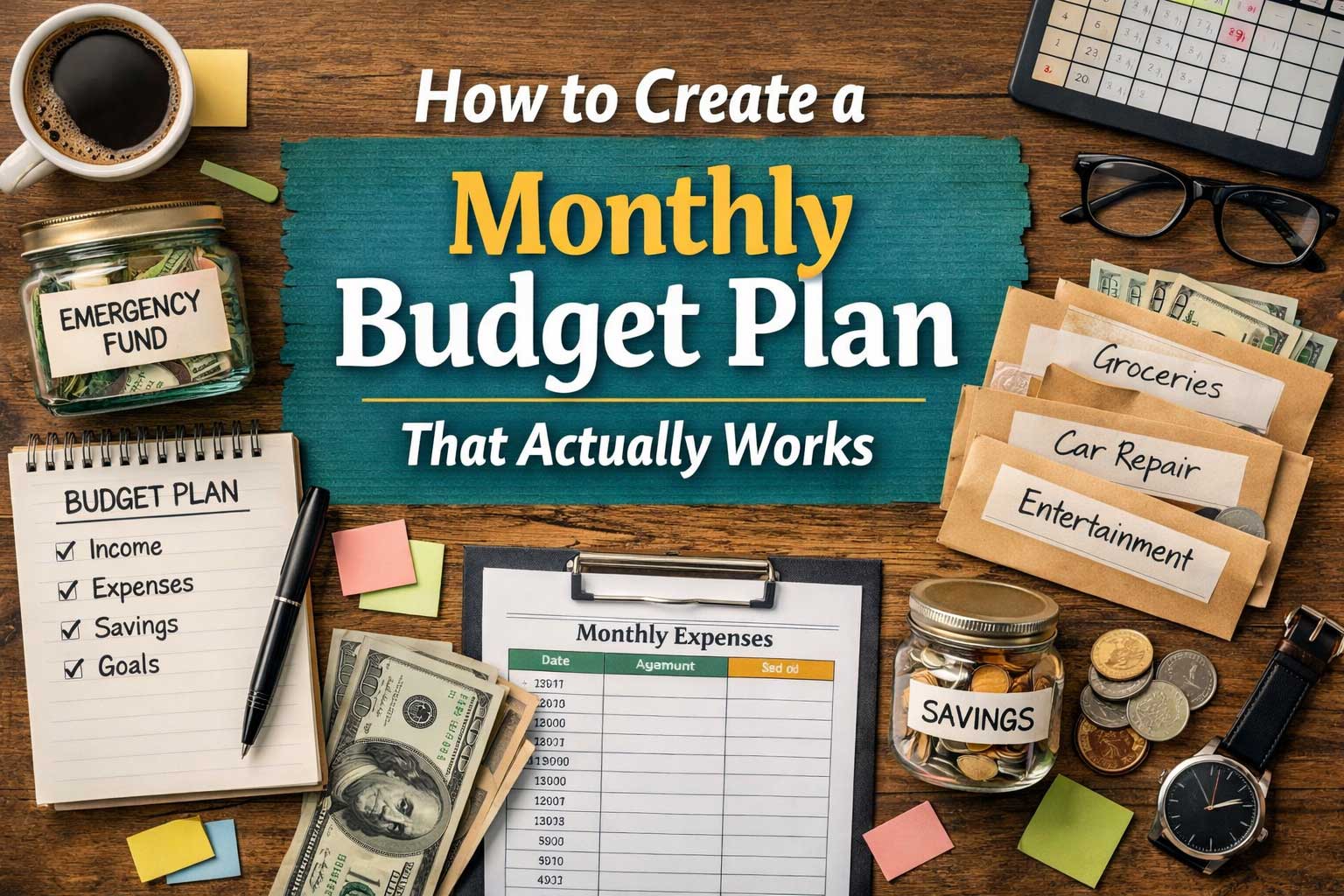
A monthly budget plan should do one thing above all: help you live your life with less money stress. Not a fantasy plan that looks perfect in a spreadsheet and collapses the moment a surprise expense shows up. Not a plan that relies on willpower every single day. Not a plan that makes you feel deprived and guilty. A budget that actually works is practical, flexible, honest, and built around how you really behave—not how you “should” behave.
If you’ve tried budgeting before and it didn’t stick, that doesn’t mean you’re “bad with money.” It usually means the budget wasn’t designed for real life. Real life includes irregular expenses, busy weeks, temptations, family needs, social events, unexpected repairs, emotional spending, and income that doesn’t arrive exactly the same way every month.
This guide will show you how to build a monthly budget system you can keep using—one that helps you pay bills on time, stop feeling behind, make room for saving, and still enjoy your life. We’ll build it step-by-step, then add the “working parts” most budgets are missing: buffer money, irregular expense planning, tracking that doesn’t consume your day, and a review process that improves the plan every month.
What “A Budget That Actually Works” Really Means
Before making categories or writing numbers, define what “works” means for you. A budget works when it:
- Pays for the month’s real expenses, not just the predictable ones.
- Prevents surprise costs from becoming debt (car repairs, gifts, medical, annual fees).
- Fits your income pattern (weekly, biweekly, monthly, irregular).
- Includes fun money so you don’t rebound-spend.
- Is simple enough to maintain even during busy or stressful times.
- Gives you control and clarity, not shame.
A working budget is not about perfection. It’s about consistency. You don’t need to track every coin forever. You need a reliable system that covers your essentials, prepares for the predictable surprises, and keeps you moving toward your goals.
Step 1: Choose the Right Budgeting Style for Your Life
Most people fail not because they “did it wrong,” but because they picked a method that doesn’t match their personality or cash flow. Choose a style that feels natural.
Option A: The “Simple Categories” Budget (Best for Most People)
You allocate monthly amounts to a short list of categories: housing, groceries, transportation, bills, debt, savings, and personal spending. You track enough to stay on target, not everything.
Why it works: It’s flexible and doesn’t require perfection.
Option B: Zero-Based Budget (Best for Tight Months or Fast Progress)
Every dollar you expect to receive is assigned a job: bills, food, savings, debt, sinking funds, fun. At the end, you have zero unassigned dollars.
Why it works: It forces clarity and reduces “mystery spending.”
Option C: Paycheck Budgeting (Best for Biweekly/Weekly Pay)
You plan per paycheck, not per month. Each paycheck covers specific bills and categories until the next payday.
Why it works: It prevents running out of money mid-month.
Option D: “Bare-Bones + Flex” Budget (Best for Burnout or ADHD-friendly setup)
You focus on essentials first, then give yourself a flexible spending limit (one number) for everything else.
Why it works: It reduces tracking fatigue and still protects your essentials.
Pick one style now. You can switch later, but starting with a clear structure matters.
Step 2: Start With Reality: Calculate Your True Monthly Income
Your income number is the foundation. If you guess, everything else will wobble.
If You Have a Fixed Salary
Use your net income (take-home pay after taxes and deductions). Use what arrives in your bank account.
If Your Income Is Irregular (Freelance, Commission, Business, Gig Work)
Use a conservative number:
- Look at the last 6–12 months.
- Identify the lowest “normal” month (not a disaster month, but a low month).
- Or use the average minus a safety margin (like 10–20%).
Rule: Budget from what you can reliably count on, not your best month.
If You Get Paid Weekly or Biweekly
Convert to monthly correctly:
- Weekly paychecks: 52 ÷ 12 = 4.33 paychecks per month
- Biweekly paychecks: 26 ÷ 12 = 2.17 paychecks per month
Many people accidentally budget as if they get exactly 4 weekly paychecks or exactly 2 biweekly paychecks every month. That creates confusion. Use the correct conversion for a monthly plan.
Include “Other Income” Carefully
If you sometimes get bonuses, gifts, overtime, or side income, don’t rely on it to pay essential bills. Treat it as:
- extra debt payoff
- extra savings
- future sinking funds
- or occasional lifestyle upgrades
This is how you build stability fast.
Step 3: Identify the Three Layers of Expenses
A budget works when it covers all three layers:
- Fixed essentials (rent/mortgage, insurance, minimum debt payments, basic utilities)
- Flexible essentials (groceries, transport, household supplies)
- Irregular but predictable expenses (car maintenance, medical, gifts, annual fees, travel, clothing)
Most budgets fail because people only plan Layer 1 and half of Layer 2, then act surprised when Layer 3 shows up. Layer 3 is not an emergency. It’s normal life.
Step 4: Build Your Budget in the Correct Order
The order matters. If you start with fun money, you’ll squeeze essentials and create stress. If you start with essentials but forget irregular expenses, you’ll get blindsided and quit.
Use this order:
- Housing & utilities
- Transportation
- Food
- Insurance
- Minimum debt payments
- Irregular expenses (sinking funds)
- Savings goals
- Lifestyle/fun
- Buffer
Let’s break each one down.
Step 5: Set Your “Must-Pay” Monthly Bills First
List every bill that must be paid to keep your life stable.
Typical Must-Pay Categories
- Rent/mortgage
- Electricity/water
- Internet/phone
- Insurance (health, car, home, life)
- Childcare/school fees
- Minimum debt payments
- Basic transportation (fuel, transit pass)
- Basic groceries
Tip: When in doubt, consider: “If I don’t pay this, will it create a serious problem this month?” If yes, it’s a must-pay.
Don’t Forget “Quarterly/Annual” Bills
Examples:
- car registration
- professional fees
- subscriptions billed annually
- property tax installments
- yearly software renewal
These belong in irregular planning (sinking funds), but you must identify them now.
Step 6: Create Sinking Funds (The Secret Ingredient)
A sinking fund is money you set aside monthly for an expense that doesn’t happen monthly but will happen eventually. This single concept is what turns budgeting from stressful to calm.
Common Sinking Funds That Make Budgets Work
- Car maintenance/repairs
- Medical and dental (co-pays, medicine)
- Gifts (birthdays, holidays, weddings)
- Home repairs
- Clothing and shoes
- Annual subscriptions and fees
- Travel
- School costs
- Electronics replacement
- Pet expenses
- Taxes (especially for self-employed)
How to Calculate Sinking Funds
For each irregular expense, estimate the yearly cost, then divide by 12.
Example:
- Car maintenance estimated at 12,000 per year → 1,000 per month
- Gifts estimated at 6,000 per year → 500 per month
If you don’t know the yearly cost, start with a small number and adjust. A budget that improves monthly is better than a budget you never start.
Why This Changes Everything
Without sinking funds, your budget has “fake free money” that gets spent. Then when a predictable expense hits, you use debt or drain savings. With sinking funds, those expenses are already paid for in advance.
Step 7: Decide on a Simple Category System (Not 40 Categories)
The more categories you have, the more likely you quit. Keep it simple, then add detail only where you need control.
A Practical Category List That Works
Essentials
- Housing
- Utilities
- Groceries
- Transportation
- Insurance
- Minimum debt payments
- Health/medical
Irregular (Sinking Funds)
- Car maintenance
- Gifts/holidays
- Home maintenance
- Annual fees/subscriptions
- Clothing
- Travel
- Education/kids
- Emergency fund (if still building)
Lifestyle
- Dining out
- Entertainment
- Personal spending
- Hobbies
- Subscriptions (monthly)
Goals
- Extra debt payoff
- Investing
- Savings goals
If you want, you can combine some:
- Combine “Dining out” + “Entertainment” into “Fun”
- Combine “Household” + “Toiletries” into “Home supplies”
Your budget is a tool, not a museum exhibit.
Step 8: Set Category Amounts Using the 70/20/10 Framework (Then Personalize)
If you’re unsure where to start, use a flexible framework:
- Needs: ~50–70%
- Financial goals: ~10–30%
- Wants: ~10–30%
This is not a rule. It’s a starting point. Your situation might be different:
- If income is low, needs might be 80% temporarily.
- If you’re focused on debt payoff, goals might be 30–40%.
- If you have high housing costs, wants may need to shrink.
How to Personalize
Ask:
- What do I must pay to be stable?
- What goals matter most right now?
- What spending categories cause my budget to break?
The category that breaks your budget is the one that needs a smarter system, not just a smaller number.
Step 9: Add a Buffer Category (Your Budget’s Shock Absorber)
A buffer is a small amount of unassigned money inside the budget that exists for real life.
Why a Buffer Prevents Failure
If you budget every dollar with no room for errors, the first surprise expense will make you feel like you “failed.” Then you abandon the plan.
A buffer says:
- “I’m human.”
- “Life happens.”
- “My plan includes flexibility.”
Start with a buffer of 1–5% of income. If money is tight, even a small buffer helps.
Step 10: Choose a Tracking Method You’ll Actually Use
Tracking is where many budgets die. Not because tracking is useless, but because people choose a method that’s too heavy.
Method 1: Weekly Check-In (Low Effort, High Success)
Once per week:
- Check category balances
- Adjust if needed
- Confirm bills are covered
- Plan the next week’s spending
This is enough for many people.
Method 2: “Caps” on Key Categories
Track only the categories that cause overspending:
- dining out
- online shopping
- groceries
- entertainment
Everything else can be auto-paid and mostly ignored.
Method 3: Cash/Envelope Style (Physical or Digital)
You “load” spending categories with limits and stop when the category is empty.
This is great for people who want strong boundaries.
Method 4: One-Number Spending Limit
After bills, sinking funds, and goals, you give yourself one weekly number:
- “I can spend up to X this week.”
Simple. Effective. Less mental work.
Choose one method today. Don’t choose the “perfect” method. Choose the one you’ll do on a tired week.
Step 11: Build Your Monthly Budget Plan Step-by-Step (A Real Example)
Let’s build it with a process you can copy.
Step A: Write Down Income
Example:
- Monthly net income: 50,000
Step B: List Must-Pay Bills (Fixed Essentials)
- Housing: 18,000
- Utilities: 2,500
- Phone/Internet: 1,200
- Insurance: 2,300
- Minimum debt payments: 3,000
Subtotal: 27,000
Step C: Add Flexible Essentials
- Groceries: 6,000
- Transportation: 3,000
- Household supplies: 1,000
Subtotal: 10,000
Running total: 37,000
Step D: Add Sinking Funds
- Car maintenance: 1,000
- Gifts/holidays: 800
- Medical: 700
- Annual fees: 500
- Home maintenance: 500
Subtotal: 3,500
Running total: 40,500
Step E: Add Goals
- Emergency fund: 3,000
- Investing: 2,000
Subtotal: 5,000
Running total: 45,500
Step F: Add Lifestyle (Wants)
- Dining out: 1,500
- Entertainment: 1,000
- Personal spending: 1,000
Subtotal: 3,500
Running total: 49,000
Step G: Add Buffer
- Buffer: 1,000
Total: 50,000
Now your plan fits reality, covers irregular expenses, includes goals, includes enjoyment, and has flexibility.
That’s a working budget.
Step 12: Make Bills Easy: Create a Bill Calendar (So You Don’t Guess)
Many people don’t fail because of spending. They fail because of timing. Money comes in at different dates than bills go out.
How to Fix Timing Problems
Create a simple bill calendar:
- Date due
- Amount
- Auto-pay? Yes/No
- Which paycheck pays it?
If your bills hit before payday, you need a “bill buffer” in checking or a system where you hold part of last month’s income to pay this month’s bills. Timing problems often feel like “I’m broke,” even when the budget is fine.
Step 13: Handle Irregular Income Without Stress
If your income varies, a traditional monthly budget can feel unstable. But you can still make it work.
Use a “Baseline Budget”
Pick a baseline income number (conservative). Build the budget based on that.
Then, when you earn above baseline:
- Fill any underfunded sinking funds
- Add to emergency savings
- Pay extra debt
- Invest
- Finally, increase lifestyle spending
This creates a system where your budget works even in low months, and great months accelerate your progress.
The “Priority Ladder” for Extra Income
When extra money arrives, decide in advance where it goes. If you don’t decide, it disappears.
A simple ladder:
- Catch up on essentials
- Build emergency fund
- Pay high-interest debt
- Fund sinking funds
- Invest
- Fun upgrades
Step 14: Stop Overspending With “Friction,” Not Willpower
A budget fails when it relies on daily self-control. The solution is to design the environment so spending is naturally limited.
Practical Ways to Add Spending Friction
- Use one card for fixed bills only, one card for spending
- Turn off “one-click” checkout
- Remove saved payment methods
- Set a 24-hour rule for non-essentials
- Set a weekly cash withdrawal for fun spending
- Use separate accounts: bills account + spending account
The goal is not to punish yourself. It’s to prevent mindless spending from stealing money meant for your priorities.
Step 15: Use Weekly Budget Meetings (10–15 Minutes)
A monthly budget doesn’t stay accurate for 30 days without a quick check-in. The trick is to keep it short.
Weekly Check-In Script
- What bills are due before the next check-in?
- How much is left in groceries?
- How much is left in fun spending?
- Any surprises coming up this week?
- Do we need to adjust categories?
That’s it. Ten to fifteen minutes.
This routine is what keeps your budget “alive” instead of a one-time document you forget.
Step 16: What to Do When You Mess Up (Because You Will)
A budget that works includes a plan for when things go off track.
The “Reset Without Shame” Process
If you overspend:
- Identify what category went over and why
- Move money from the buffer or another flexible category
- If needed, reduce next week’s fun spending slightly
- Write a simple note: “This category needs a better plan”
Overspending is information. It’s not a moral failure. It tells you either:
- your category limit was unrealistic, or
- you’re using spending to solve an emotional need, or
- you forgot an irregular expense, or
- your system is too hard to maintain.
Fix the system, not your self-worth.
Step 17: How to Budget for Groceries (The Category That Breaks Many Budgets)
Groceries are flexible, necessary, and easy to overspend. You need a strategy, not just a number.
A Grocery Strategy That Works
- Set a weekly grocery amount (monthly ÷ 4)
- Shop once or twice per week (not daily)
- Keep a “default list” of staples
- Plan meals around affordable proteins and seasonal produce
- Use a “stretch week” plan: low-cost meals for the last week if needed
Add a “Household Supplies” Category
Many people mix toiletries, cleaning supplies, and paper goods into groceries. That makes grocery spending look out of control. Separate it if your grocery number keeps breaking.
Step 18: How to Budget for Eating Out Without Giving Up Your Social Life
Budgets fail when they ban everything enjoyable. Instead of banning eating out, control it.
Use “Rules” Instead of Random Choices
Examples:
- “Two meals out per week”
- “Only eat out on weekends”
- “Coffee at home weekdays”
- “Restaurants only with friends, not alone”
- “Max spend per outing”
These rules reduce decision fatigue and protect your category limit.
Step 19: Debt Payoff vs Saving: How to Balance Both
A budget plan works when it builds safety while improving the future.
A Practical Balance
- Pay minimums on all debts
- Build a starter emergency fund (so you don’t go back into debt)
- Attack high-interest debt
- Increase savings and investing as debt shrinks
If you put every extra dollar toward debt while having no savings, a small emergency can push you backward. Your budget should prevent backsliding.
Step 20: Make Your Budget Automatic Where Possible
Automation reduces stress and increases consistency.
Automate These First
- Bills on auto-pay (when safe)
- Automatic transfer to savings on payday
- Automatic transfer to sinking funds
- Automatic investing (if appropriate)
If money is tight and timing is tricky, automate after you’ve stabilized the bill calendar. But the long-term goal is clear: the budget should run even when you’re busy.
Step 21: Use a “Monthly Budget Review” to Improve the System
The difference between people who quit budgeting and people who master it is this: a working budget is reviewed and adjusted monthly.
End-of-Month Review Questions
- Which categories were easy to stay within?
- Which categories broke, and why?
- Did any irregular expenses surprise me?
- Are my sinking funds realistic?
- Did I make progress toward goals?
- What one change would make next month easier?
Pick one improvement each month. Small improvements compound into a powerful system.
Step 22: Common Reasons Budgets Fail (And How to Fix Them)
Problem 1: The Budget Is Too Strict
Fix: Add lifestyle money and a buffer. Strict budgets trigger rebound spending.
Problem 2: You Forgot Irregular Expenses
Fix: Add sinking funds. This is the #1 technical reason budgets collapse.
Problem 3: Tracking Is Too Complicated
Fix: Track less. Use caps on the top 2–3 problem categories.
Problem 4: Income Timing Doesn’t Match Bills
Fix: Use paycheck budgeting or build a bills buffer.
Problem 5: You’re Budgeting for a Perfect Month
Fix: Budget for your real month: birthdays, repairs, travel, back-to-school, holidays.
Problem 6: You Treat the Budget Like a Test
Fix: Treat it like navigation. If you take a wrong turn, you adjust—you don’t quit driving.
Step 23: A Monthly Budget Template You Can Copy (Simple and Effective)
Here’s a clean structure that works for most people:
1) Income
- Net monthly income: ______
2) Fixed Essentials
- Housing: ______
- Utilities: ______
- Phone/Internet: ______
- Insurance: ______
- Minimum debt payments: ______
- Childcare/School: ______
Subtotal: ______
3) Flexible Essentials
- Groceries: ______
- Transportation: ______
- Household supplies: ______
- Health/Medical basics: ______
Subtotal: ______
4) Sinking Funds (Irregular Expenses)
- Car maintenance: ______
- Gifts/Holidays: ______
- Annual fees: ______
- Home repairs: ______
- Clothing: ______
- Travel: ______
Subtotal: ______
5) Goals
- Emergency fund: ______
- Extra debt payoff: ______
- Investing: ______
Subtotal: ______
6) Lifestyle
- Dining out: ______
- Entertainment: ______
- Personal spending: ______
- Subscriptions: ______
Subtotal: ______
7) Buffer
- Buffer: ______
Total planned spending: ______ (should match income)
This template keeps things simple while still covering real life.
Step 24: How to Make It “Actually Work” Starting This Month
Reading is helpful. Action is better. Here’s how to implement quickly without overwhelm.
Day 1: Set Up Your Categories and Baseline Numbers
- Income
- Must-pay bills
- groceries/transport
- 3–5 sinking funds
- one savings goal
- one fun category
- buffer
Keep it small. You can expand later.
Day 2: Create Your Bill Calendar
Write down dates and amounts. Decide which paycheck covers each bill.
Day 3: Add One Spending Control
Pick just one:
- weekly spending limit
- cash envelope for dining out
- separate account for bills
- remove saved cards from shopping apps
End of Week: Do the 10-Minute Check-In
Adjust categories if needed. Don’t aim for perfection—aim for awareness.
End of Month: Do a Review and Improve One Thing
That one thing might be:
- raise groceries slightly and reduce eating out
- add a “car maintenance” sinking fund
- create a small “medical” fund
- automate a savings transfer
This is how budgets become effortless over time.
Step 25: A Real-Life Mindset Shift That Keeps Budgets Working
A budget isn’t a punishment. It’s a plan that protects what matters to you.
When your budget includes:
- your real bills,
- your real spending patterns,
- your future goals,
- and your real-life surprises,
you stop feeling like money is a constant emergency. You stop guessing. You stop reacting. You start deciding.
A monthly budget plan that actually works doesn’t demand a perfect person. It builds a reliable system for a normal person.
And that’s the whole point.
Frequently Asked Questions
How long does it take for a monthly budget to start working?
Most people feel improvement in the first month because clarity reduces stress. Real stability usually builds over 3–6 months as sinking funds grow and the plan becomes accurate.
Should I budget based on last month or this month?
Start with this month using conservative income and real bills. Then use your monthly review to make next month more accurate. If your income is irregular, baseline budgeting works best.
What if I keep overspending in one category?
That category needs a strategy, not just a smaller number. Add friction, set weekly limits, use cash, or build a realistic amount based on your patterns.
Do I need to track every expense?
No. Track what helps you make decisions. Many people only track their problem categories and check totals weekly.
What’s the difference between an emergency fund and a sinking fund?
A sinking fund is for expected expenses that don’t happen monthly (gifts, repairs). An emergency fund is for unexpected, truly unplanned events (job loss, major emergency).