
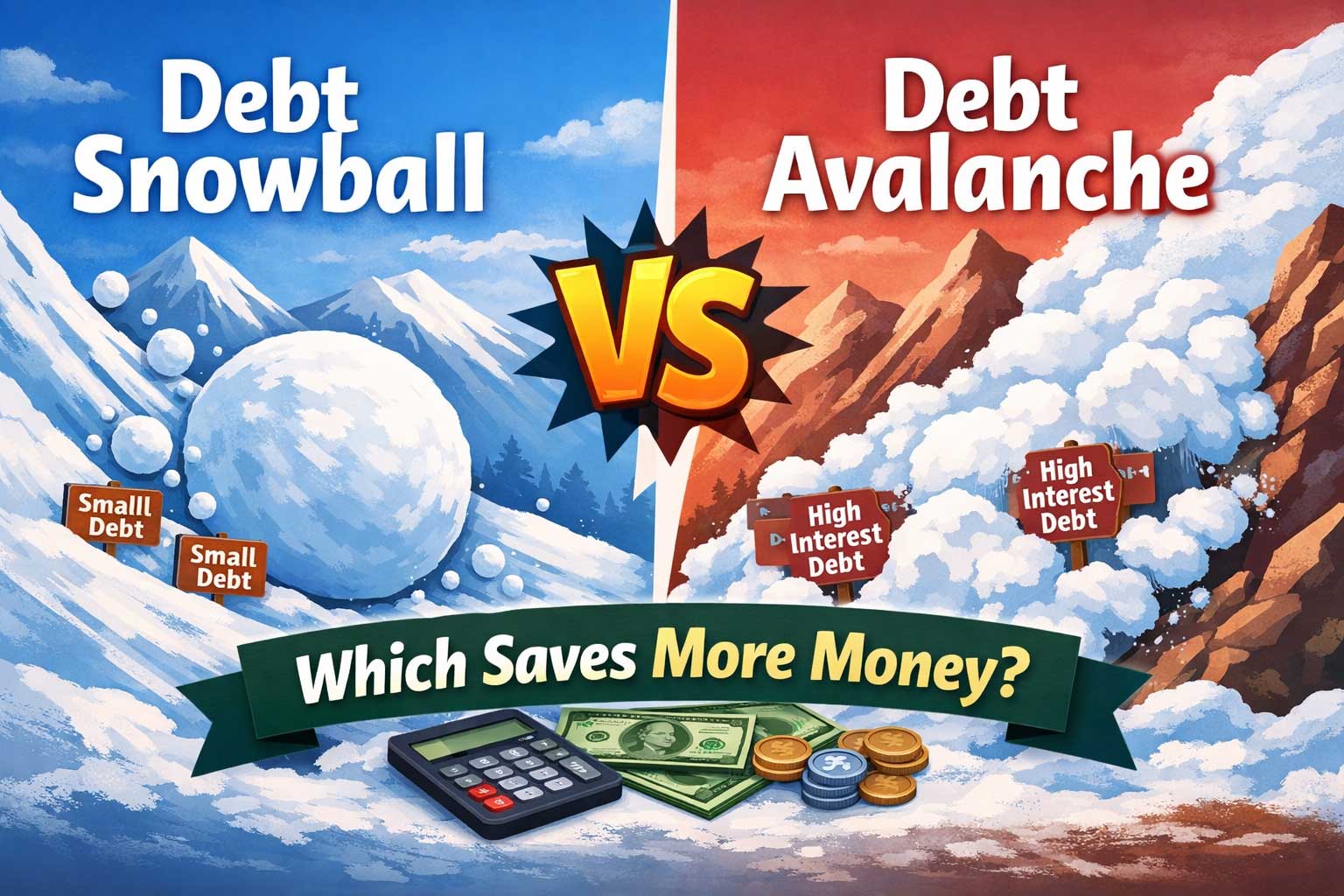
Debt can feel like a heavy backpack you never get to put down. Even when you’re making payments, the balance barely moves, interest keeps piling on, and your budget feels squeezed from every angle. When people decide to get serious about paying off debt, they usually run into the same fork in the road:
- Debt Snowball: Pay off the smallest balances first to build momentum.
- Debt Avalanche: Pay off the highest interest rates first to save the most money.
Both methods work. Both can be life-changing. But they don’t behave the same way in real life. One method often saves more in interest. The other often wins the motivation game and helps people stick with it long enough to finish.
This article breaks down both strategies in a deep, practical way—so you can choose the method that not only looks best on paper, but actually helps you get out of debt faster and stay out for good.
The Real Goal: Pay Off Debt With a System You’ll Actually Follow
Before comparing snowball vs avalanche, it helps to define success.
Debt payoff isn’t a single moment. It’s a long sequence of decisions: skipping purchases, renegotiating bills, staying consistent, adjusting after setbacks, resisting “just this once,” and continuing even when progress feels slow. That means the “best” method is not just the one that saves the most interest in theory—it’s the one that you can follow consistently until the final balance is gone.
So we’ll answer two questions:
- Which method saves more money (interest)?
- Which method is more likely to help you finish?
If you pick the wrong strategy for your personality and situation, even the mathematically perfect plan can fail. But if you pick a strategy that fits you, the results can be dramatic.
Step Zero: The Rules Both Methods Share
Debt snowball and debt avalanche are different prioritization systems, but they share the same foundation. If you don’t follow these rules, neither method will perform well.
Rule 1: List every debt clearly
You need a complete list of:
- Creditor name
- Balance
- Minimum payment
- Interest rate (APR)
- Due date
- Type of debt (credit card, personal loan, auto, student loans, medical, etc.)
When you can see your debts as a full picture, the chaos becomes a plan.
Rule 2: Always pay minimums on every debt (except the one you’re attacking)
Your minimum payments keep accounts current and prevent late fees, penalty APRs, and credit damage. Late fees and penalty rates can destroy your payoff plan.
Rule 3: Put every extra dollar toward one “target debt”
If you spread extra money across multiple debts, it feels productive—but it slows your progress. Concentrating extra payments creates faster wins and reduces total payoff time.
Rule 4: When a debt is paid off, roll that payment into the next debt
This is the “rollover” effect. It’s what makes both methods powerful over time.
Your payment power grows like a snowball rolling downhill—not because balances magically shrink, but because your minimum payments turn into extra money once a debt is gone.
Rule 5: You need a steady monthly surplus
No strategy can beat a budget that doesn’t work. Your debt payoff speed depends on your surplus:
Monthly surplus = income – essentials – minimum debt payments
Even a small surplus can work. But you must protect it.
What Is the Debt Snowball Method?
The Debt Snowball method prioritizes debts from smallest balance to largest balance, regardless of interest rate.
How it works
- List debts from smallest balance to largest.
- Pay minimums on all debts.
- Put all extra money toward the smallest balance.
- When the smallest balance is paid off, roll its payment into the next smallest debt.
Why people love it
The snowball method produces quick wins, which builds motivation. If you’re overwhelmed, frustrated, or tired of feeling behind, quick wins can feel like oxygen.
The psychology behind snowball
Many people don’t quit debt payoff because they can’t do math. They quit because they feel:
- progress is too slow
- the effort isn’t worth it
- “I’ll never finish anyway”
- an emergency derails them and they give up entirely
Debt snowball attacks these emotional barriers by creating early victories. Seeing a debt disappear is powerful. It proves you can win.
What Is the Debt Avalanche Method?
The Debt Avalanche method prioritizes debts from highest interest rate to lowest interest rate, regardless of balance size.
How it works
- List debts from highest APR to lowest APR.
- Pay minimums on all debts.
- Put all extra money toward the highest-interest debt.
- When that debt is paid off, roll its payment into the next highest-interest debt.
Why people love it
The avalanche method is the math-driven strategy. Because high-interest debt grows faster, paying it off first typically:
- reduces total interest paid
- shortens overall payoff time (often)
- makes each dollar work harder
The “math advantage”
Interest is the cost of borrowing. If you eliminate the most expensive borrowing first, you reduce the “leak” in your financial bucket. That means more of your payment goes to principal over time.
Which Method Saves More Money?
If we only care about interest paid, the answer is usually:
Debt Avalanche saves more money.
Because avalanche targets the highest interest first, it reduces the amount of interest that accumulates over the payoff period. In many scenarios, avalanche also pays off the entire debt stack faster, though the difference can be small or large depending on balances and rates.
But “usually” matters. There are cases where:
- the difference is tiny
- your snowball and avalanche order is nearly the same
- behavior changes the outcome
So we’ll go deeper and show how to evaluate it realistically.
A Practical Example: Snowball vs Avalanche (Same Budget, Different Order)
Let’s imagine you have these debts:
- Credit Card A: $600 balance, 24% APR, $25 minimum
- Credit Card B: $2,800 balance, 18% APR, $85 minimum
- Personal Loan: $6,500 balance, 10% APR, $210 minimum
- Car Loan: $12,000 balance, 6% APR, $290 minimum
Assume you can pay $700/month total toward debt.
Your minimum payments add up to:
$25 + $85 + $210 + $290 = $610 minimum total
So your extra money is:
$700 – $610 = $90 extra per month
Debt Snowball order (smallest to largest)
- $600 (CC A)
- $2,800 (CC B)
- $6,500 (loan)
- $12,000 (car)
Snowball would likely wipe out CC A quickly. Once it’s gone, your payment power grows by $25 per month (its minimum) plus the extra you were adding.
Debt Avalanche order (highest APR to lowest)
- 24% (CC A)
- 18% (CC B)
- 10% (loan)
- 6% (car)
In this specific example, the first debt is the same for both methods because it’s both the smallest and highest interest. So the difference may be small overall.
That’s an important point: Sometimes the methods are nearly identical in practice.
Where the methods diverge dramatically is when:
- your smallest debts have low APR
- your largest debts have high APR
- you have a big spread in interest rates
When Avalanche’s Savings Are Biggest
Debt avalanche saves the most when these conditions are present:
1) Big interest rate gaps
If you have a 29% credit card and a 6% auto loan, paying the 29% first can save a lot.
2) Large high-interest balances
If the high-APR debt is not only expensive but also large, it’s accumulating interest aggressively each month.
3) Long payoff timelines
The longer you carry high-interest debt, the more you pay in interest. Avalanche is especially valuable if you’re otherwise looking at a multi-year payoff.
4) Your budget surplus is modest
If you don’t have a huge extra payment each month, interest can keep dragging the process. Avalanche fights that drag.
When Snowball Can Be Better in Real Life (Even If It Costs More Interest)
Snowball’s advantage isn’t the interest math. It’s the behavior.
Snowball can outperform avalanche if it helps you:
- avoid quitting
- avoid taking on new debt
- stay consistent through setbacks
- keep your budget tight month after month
A strategy that saves $1,200 in interest but causes you to quit after 4 months saves you nothing. Meanwhile a strategy that costs $1,200 more in interest but gets you debt-free is the winning strategy.
Snowball is often best when:
- you feel overwhelmed by many small debts
- you need a quick confidence boost
- you’ve failed at debt payoff before
- you struggle with consistency
- you have anxiety around money and need emotional wins
The Hidden Cost Most People Ignore: “Motivation Interest”
There’s a real-world cost that isn’t in your APR: the cost of giving up.
Let’s call it “motivation interest.” It looks like:
- missed payments that trigger fees
- penalty interest rates
- increased balances from stress spending
- borrowing again because you feel stuck
- losing momentum for months or years
Debt snowball minimizes this risk by giving you early proof that the plan is working.
Debt avalanche minimizes financial interest but can feel slow if your highest-rate debt is large.
The Biggest Truth: Your Best Method Depends on the Gap Between Math and Behavior
If you’re highly disciplined and you’ll stick to the plan either way, avalanche usually wins financially.
If you’re not sure you’ll stick with it, snowball might win by helping you finish.
So the real question becomes:
Which method are you more likely to follow consistently for 12–36 months (or longer) until you’re debt-free?
How Interest Actually Works (And Why Avalanche Usually Saves More)
To understand why avalanche saves more, you need to understand what your payment is doing every month.
Your monthly payment is split into:
- interest
- principal
Your interest is calculated based on:
- your balance
- your interest rate
- your compounding schedule (often daily for credit cards)
High APR means more of your payment gets eaten by interest, especially early on.
So when you focus extra money on a high-APR debt, you reduce the balance faster, which reduces the interest charge faster, which makes more of your next payments go to principal.
It’s a compounding advantage—but in your favor.
The Speed Factor: Which Pays Off Faster?
Often, avalanche is also faster, but not always by much. The time difference depends on:
- how different your APRs are
- how balances compare
- minimum payment structures
- your monthly extra payment amount
If the interest rates are close (say everything is 12–16%), the difference between methods may be tiny.
If rates are far apart (like 29% credit cards and 5% loans), avalanche can reduce payoff time significantly.
But again, speed is meaningless if you can’t stay consistent.
A Real-World Problem: Many People Don’t Know Their True Interest Rates
To use avalanche correctly, you need accurate APRs. This sounds simple, but many people have:
- promotional 0% APR periods that end
- variable rates
- different APRs for purchases vs cash advances
- penalty APR triggers
If you choose avalanche, make sure you’re using the right interest rate and that you’re tracking changes.
If your 0% promo ends in 6 months and jumps to 24%, that debt may need to move higher on your priority list.
Handling 0% APR Debt: Snowball and Avalanche Both Need Adjustments
A common situation: you have a 0% promotional balance transfer card.
Should you pay off 0% debt first?
It depends on the deadline.
If the 0% ends and interest will explode, or if there’s deferred interest, it may be urgent.
A smart approach is to treat 0% debt as having a “future APR”:
- If promo ends soon, prioritize it like high-interest debt.
- If promo is long and stable, focus on higher-interest balances first.
If you ignore the promo deadline, you can lose thousands to interest later.
The “Debt Type” Factor: Not All Debt Is Equal
Interest rate matters, but debt type matters too:
Credit cards
- high APR
- revolving
- easy to add more debt
- often the most dangerous if you’re still using them
Personal loans
- fixed payments
- fixed timeline
- still can be expensive but less flexible
Auto loans
- may have lower rates
- risk of repossession if delinquent
- sometimes tied to transportation needs
Student loans
- may have benefits, deferment options, income-based repayment
- could be low or moderate APR
- rules vary by country and loan type
Medical debt
- sometimes low or no interest
- may be negotiable
- can have different collection rules
This matters because your plan should reduce the biggest risk first—not only the biggest APR.
How to Choose the Best Method for You (Decision Framework)
Here’s a practical framework that makes the decision obvious.
Choose Debt Avalanche if:
- you’re motivated by logic and optimization
- you can stay consistent even without quick wins
- you have large high-interest balances
- interest rates vary widely across debts
- you want to minimize total interest paid
- you already have good budgeting discipline
Choose Debt Snowball if:
- you need quick wins to stay motivated
- you feel overwhelmed by many accounts
- you’ve quit debt plans before
- you want faster emotional progress
- small debts are causing stress and mental clutter
- you’re rebuilding financial confidence
Choose a Hybrid if:
- you want the best of both
- you have a 0% promo expiring soon
- you have one debt that’s psychologically draining
- you need structure but also motivation
- your highest APR debt is huge and feels discouraging
The Hybrid Strategy: A “Snowball Start” With an Avalanche Finish
A powerful approach many people use:
- Pay off one or two smallest debts first to create momentum.
- Then switch to avalanche to maximize savings.
This can be ideal if you’re overwhelmed but still want to reduce interest costs.
Another hybrid:
- avalanche except you first eliminate any tiny debt that can be cleared in 1–2 months (to reduce accounts and stress)
The Step-by-Step Setup (Works for Snowball and Avalanche)
If you want results, your setup matters as much as your method.
Step 1: Create a “debt payoff budget”
This is not a normal budget. It’s a budget designed to produce a surplus.
Focus on:
- housing
- utilities
- food
- transportation
- insurance
- minimum debt payments
- a small buffer category (for irregular expenses)
Then direct everything else to your payoff target.
Step 2: Build a starter emergency buffer
Many people skip this and get derailed.
A starter buffer prevents you from using credit cards again for surprises. Even a small buffer helps.
The goal is not to fully protect you from all emergencies. It’s to reduce the odds that a small emergency becomes new debt.
Step 3: Freeze new debt creation
If you keep adding debt, your payoff plan becomes a treadmill.
Practical ways to stop new debt:
- stop using credit cards temporarily
- remove saved cards from online shopping
- use cash/debit for daily purchases
- set spending rules (24-hour wait for non-essentials)
- reduce triggers (shopping apps, impulse browsing)
Step 4: Automate minimum payments
Automation prevents late fees, which are payoff killers.
Step 5: Manually pay extra on the target debt
Make the extra payment intentionally each month so you stay engaged with progress.
The Motivation Engine: How Each Method Feels Month to Month
Snowball emotions
- You see accounts disappear sooner
- You feel lighter as bills reduce
- You feel more in control quickly
- The plan feels rewarding early
Avalanche emotions
- You feel smart and efficient
- Progress may look slow at first if the top APR debt is large
- You may need patience and stronger internal motivation
- You often see bigger “interest saved” over time
Neither emotional profile is “better.” The point is: know yourself.
What If Your Smallest Debt Has the Highest Interest Too?
Then the debate is easy: both methods start the same. You’ll get early wins and you’ll save interest.
In many real debt lists, the first 1–2 debts are the same order for both methods. That means the difference may not be dramatic. People often think the choice is huge, but sometimes it’s not.
What matters most is starting and staying consistent.
Common Mistakes That Make Both Methods Fail
Mistake 1: Not knowing your real “extra payment”
If you don’t know exactly how much surplus you have each month, you’ll either:
- overestimate and burn out
- underestimate and go slower than necessary
Mistake 2: Treating irregular expenses as “emergencies”
If you don’t plan for:
- car repairs
- school fees
- annual insurance payments
- medical copays
- holidays
then you’ll keep using debt and feel like you’re “failing.”
Irregular expenses are normal, not emergencies.
Mistake 3: Switching methods too often
Pick a method, commit for at least several months, and track progress. Constant changes create confusion and reduce momentum.
Mistake 4: Celebrating by spending
Some people pay off a debt and then “reward themselves” with purchases that recreate the problem.
Celebrate in a way that doesn’t create new debt:
- free experiences
- small planned treat already in budget
- a meaningful milestone ritual
Mistake 5: Ignoring interest rate changes
If your rates change, your avalanche order might change. Track it.
The “Minimum Payment Trap” and Why Your Extra Payment Matters More Than Your Method
If you only pay minimums, most debts—especially credit cards—can take years or decades.
Your extra payment is the engine. The method is the steering wheel.
If your extra payment is $20/month, the method matters less than increasing that extra payment.
If your extra payment is $500/month and you have large high-interest balances, the method can matter more.
So don’t obsess over the method while ignoring ways to increase your monthly surplus.
How to Find Extra Money Without Feeling Miserable
A debt payoff plan that makes you feel deprived often collapses. You need a plan that is disciplined but sustainable.
High-impact cuts that often work
- renegotiate internet and phone plans
- cancel unused subscriptions
- reduce delivery and takeout frequency
- meal plan to avoid food waste
- lower energy usage
- shop insurance rates
- pause non-essential memberships temporarily
High-impact income boosts
- sell unused items (short-term boost)
- overtime or side work for a season
- freelance/skills-based work
- short-term project work
- negotiate pay or hours if possible
The key mindset shift
Instead of “I can’t,” think:
- “I’m buying my freedom.”
- “Every extra dollar shortens the timeline.”
- “This is temporary, the results are permanent.”
How to Measure Which Method Saves More Money for Your Situation (Without Complicated Math)
You don’t need advanced formulas to compare.
The quick comparison method
- Write your debts in both orders:
- Snowball: by balance
- Avalanche: by APR
- Identify where they differ.
- Ask:
- Is a very high APR debt being delayed under snowball?
- How large is that debt?
- How long would it take before snowball reaches it?
If snowball would delay a 25% APR debt for a year while you focus on low-interest small balances, avalanche likely saves meaningfully.
If the difference is only a few months or the APR spread is small, snowball may be worth it for motivation.
Choosing Based on Your “Debt Personality”
People underestimate how much personality affects payoff success.
If you’re motivated by visible progress
You’ll likely stick better with snowball.
If you’re motivated by efficiency and optimization
You’ll likely stick better with avalanche.
If you’re anxious and avoid checking accounts
Snowball can reduce stress faster by eliminating accounts.
If you love spreadsheets and tracking
Avalanche will feel satisfying because it’s “correct” financially.
If you’re burned out and feel defeated
Snowball can restore hope quickly.
If you’re stubborn and competitive
Either works—but avalanche may feel like winning against interest.
What About Credit Score Impact?
Debt payoff methods can affect credit scores indirectly, but neither is “the credit score method.” Your credit score depends on several factors, including utilization and payment history.
Paying off credit cards helps utilization
Credit utilization can drop when balances drop, which may improve your score.
Closing accounts can reduce available credit
If you close a credit card after paying it off, your total available credit might decrease, which could increase utilization percentage. But this depends on your situation.
Late payments are far worse
The most important credit score action during debt payoff is staying current. Automated minimum payments protect you.
If credit score improvement is a major goal, focus on:
- on-time payments
- reducing revolving utilization (credit cards)
- avoiding new debt applications
What If You Have Collections or Past-Due Accounts?
If you have accounts in collections or behind on payments, your priority might be different. Before snowball or avalanche, you may need to stabilize:
- bring current accounts up to date
- stop late fees and penalty rates
- negotiate payment plans where possible
- prevent further credit damage
After stability, snowball/avalanche becomes your payoff engine.
What If You’re Married or Sharing Finances?
Debt payoff gets more complex with shared money because:
- different tolerance levels
- different emotional triggers
- different spending habits
- different financial goals
In couples, snowball often works well because both people can see visible progress. But avalanche can also work if both agree on the math.
A smart approach is to:
- choose the method together
- set monthly “check-in” meetings
- agree on boundaries around new spending
- treat it as a joint project, not a personal flaw
How to Prevent “Debt Relapse” After You Finish
Paying off debt is step one. Staying debt-free is step two.
Here’s what causes relapse:
- no emergency fund
- lifestyle inflation
- returning to old habits
- not having a plan for irregular expenses
- using credit for convenience without discipline
The debt-free transition plan
Once debt is gone, redirect that same payment power into:
- Emergency fund building (until it covers real emergencies)
- Long-term savings goals (home, education, business)
- Investing for wealth building
- Sinking funds for irregular expenses
Your debt payoff payment becomes your wealth-building payment.
That’s how people become financially unbreakable.
Quick Summary: Which Saves More Money?
If you follow both plans perfectly:
- Debt Avalanche usually saves more money (less interest paid).
- It can also be faster, especially with large high-interest balances.
If motivation is a challenge:
- Debt Snowball can be the better choice because it increases your odds of sticking with the plan.
The best method is:
- the one you can follow consistently until every balance is gone.
Final Recommendation: Pick One Today and Start This Month
If you’re still undecided, choose this simple rule:
- If you have high-interest credit card debt and you can stay disciplined, choose Avalanche.
- If you feel overwhelmed, stressed, or you’ve failed before, choose Snowball.
- If you want both, do a hybrid: one quick win, then avalanche.
The most expensive month of debt is the month you do nothing. The method matters—but starting matters more.
Frequently Asked Questions
1) Can I switch methods later?
Yes, but avoid switching too often. Many people start with snowball for early wins and switch to avalanche once momentum is built.
2) What if my highest-interest debt is also my largest debt and it feels impossible?
That’s a common avalanche challenge. A hybrid plan can help: clear one small debt first, then go back to the high-interest debt with more payment power.
3) Should I pay off loans or credit cards first?
Credit cards usually have higher interest and more risk of growing balances. In many cases, prioritizing high-interest revolving debt first is wise.
4) Should I invest while paying off debt?
It depends on interest rates, risk tolerance, and financial stability. Many people prioritize high-interest debt payoff before serious investing, while still building a basic emergency buffer.
5) What if I have a 0% APR promotional balance?
Track the end date. If the rate will jump soon, treat it as urgent and plan to pay it off before the promo expires.