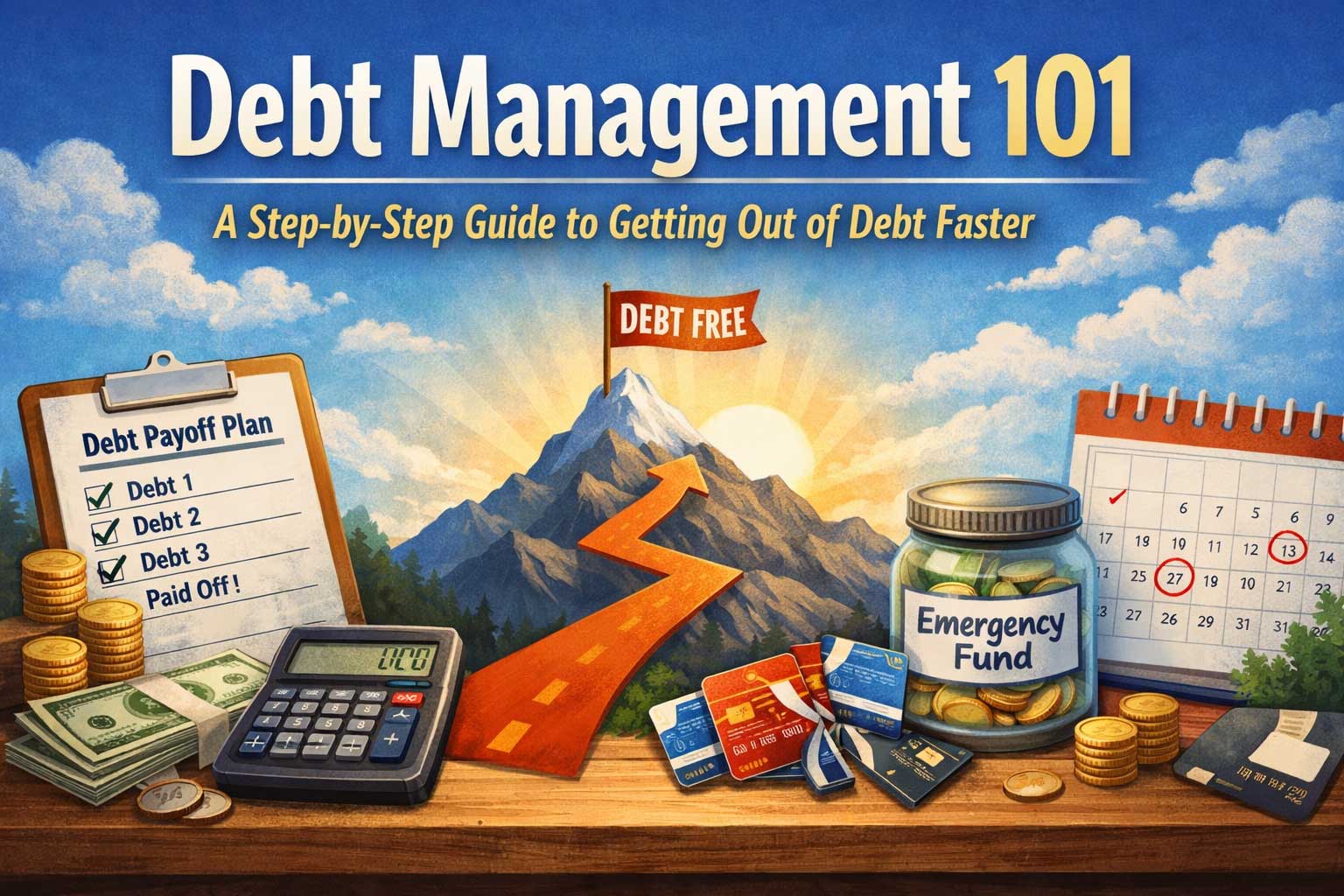
Debt can feel like a weight that follows you everywhere. It affects your choices, your stress level, your confidence, and even how you see your future. The good news is that debt is not a life sentence. For most people, it’s a problem of structure, strategy, and consistency, not personal failure. When you build a clear plan and execute it steadily, you can reduce debt faster than you think, and more importantly, you can stay out of it.
This guide is designed to be practical. It is not a motivational poster. It’s a complete step-by-step system you can apply whether you have credit card balances, personal loans, buy-now-pay-later plans, medical debt, student loans, car loans, or a mix of several. You’ll learn how to stabilize first, then accelerate payoff, then protect your progress so you don’t slide backwards.
You will see numbers, frameworks, and decision rules you can use immediately. You’ll also learn how to handle common setbacks like inconsistent income, emergencies, family obligations, and “I’m doing everything right but it’s still slow” frustration. Debt management is a skill, and like any skill, it gets easier once you have the right tools.
What Debt Management Really Means (And What It Doesn’t)
Debt management is the process of controlling, organizing, and reducing your debt in a way that protects your essential needs and improves your financial health over time. It involves:
- Knowing exactly what you owe, to whom, and at what cost
- Creating a plan that fits your income and your life
- Making your payments on time consistently
- Reducing interest and fees wherever possible
- Paying extra strategically to eliminate balances faster
- Building habits and safeguards so debt doesn’t return
Debt management is not the same as being debt-free overnight. It’s also not about extreme deprivation. The fastest debt payoff plan is the one you can actually follow for months and years without burnout. People often fail not because they lack discipline, but because their plan is too fragile. A single unexpected expense breaks it.
Your goal is to build a plan that is both aggressive and realistic.
Step 1: Get Clear on Your Debt Picture (No Guessing)
You can’t manage what you don’t measure. Many people try to “feel” their way out of debt, paying a little here and there, hoping it improves. That approach is slow and stressful because it lacks direction.
Build a Debt Inventory (Your Debt Dashboard)
List every debt and include:
- Creditor or lender name
- Type of debt (credit card, loan, BNPL, student loan, etc.)
- Current balance
- Interest rate (APR)
- Minimum monthly payment
- Due date
- Any fees or penalties
- Whether it’s secured (car loan) or unsecured (credit card)
- Whether it is current, past due, or in collections
If you’re missing details, check statements or contact the lender. Don’t rely on memory.
Calculate Your Debt Snapshot Numbers
These give you clarity and motivation because you can track progress.
- Total debt balance: add everything
- Total minimum payments: add all minimums
- Weighted average interest rate (rough): not required, but helpful
- High-cost debts: debts with the highest interest or fees
- Delinquency risk: debts that could trigger late fees, interest spikes, repossession, or legal action
Why This Matters
Debt payoff speed isn’t only about income. It’s about leakage (fees, interest, penalties), prioritization (which balances cost you the most), and execution (automations and routines).
A complete debt list transforms debt from a fog into a map. Once you have a map, you can choose the fastest route.
Step 2: Stabilize Your Situation Before You Go “All In”
Many people rush to pay extra on debt while their basics are unstable. That often backfires. If you don’t stabilize first, you’ll end up using credit again when something goes wrong.
Stabilizing means building a foundation that prevents new debt while you pay old debt down.
Create a “Debt Safety Budget” (The Non-Negotiables)
Start with your essentials:
- Housing
- Utilities
- Food
- Transportation to work
- Minimum debt payments
- Basic healthcare
- Necessary childcare
- Insurance (as needed)
These categories are not about comfort; they’re about survival and stability.
Then identify “flex categories”:
- Eating out
- Entertainment
- Shopping
- Subscriptions
- Convenience spending
- Travel
- Gifts above what you can afford
Debt payoff accelerates when you shrink flex categories temporarily.
Build a Starter Emergency Buffer (Yes, Before Extra Debt Payments)
If you have no savings, even a small surprise can push you back into debt. A starter buffer is not meant to make you rich. It’s meant to make your plan durable.
A practical target is a small amount you can build quickly. The exact number is less important than the function: you need a “shock absorber.”
This buffer should be kept separate so you don’t casually spend it.
Stop the Bleeding: Prevent New Debt
Debt payoff is slow if you’re still adding new balances. Your first mission is to stop new debt from being created.
Actions that help:
- Pause non-essential spending
- Remove saved cards from shopping apps
- Unsubscribe from temptation marketing emails
- Use cash or debit for variable categories
- Set spending limits in your banking app
- Freeze credit card usage temporarily (some people literally put cards away)
This step isn’t forever. It’s a strategic phase. Think of it like a financial detox to break the cycle.
Step 3: Choose a Debt Payoff Method (And Pick One)
Two core payoff strategies dominate for a reason: they work.
Method A: Debt Avalanche (Mathematically Fastest)
You pay minimums on all debts, then put every extra dollar toward the debt with the highest interest rate first. After it’s paid off, you roll that payment to the next-highest interest debt.
Pros:
- Typically saves the most money
- Often gets you out of debt faster in total months
- Best when interest rates are high
Cons:
- Early wins may feel slower if the highest-interest balance is big
- Motivation can dip if you don’t see quick closures
Method B: Debt Snowball (Psychologically Fastest)
You pay minimums on all debts, then put every extra dollar toward the smallest balance first. When it’s paid off, roll that payment to the next-smallest.
Pros:
- Quick wins early
- Easier to stick with for many people
- Builds confidence and momentum
Cons:
- Can cost more interest overall if high-interest debts are delayed
Which One Should You Pick?
Pick the one you will stick to without quitting.
- If you’re motivated by math and efficiency, avalanche is great.
- If you’re overwhelmed, snowball is often better because it creates momentum and reduces the number of bills fast.
- A hybrid works too: pay off tiny nuisance balances first (for simplicity), then switch to avalanche.
The worst choice is not choosing at all and paying randomly.
Step 4: Create Your “Debt Attack Number” (The Engine of Speed)
Your debt payoff speed depends on one key number:
Debt Attack Number = Total amount you can pay toward debt each month – Total minimum payments
Example conceptually:
- If your minimums are manageable and you can add extra each month, you’ll accelerate payoff.
- If you can only afford minimums, your plan needs cost reduction, income increase, or debt restructuring.
How to Increase Your Debt Attack Number
You have two levers: reduce expenses and increase income. Most people use both.
Expense Reductions That Usually Matter Most
- Housing: negotiate rent renewal, get a roommate, move if possible
- Transportation: reduce car costs, refinance if appropriate, use public transport, sell an expensive vehicle if it’s draining you
- Food: meal planning, reduce delivery, cook in bulk
- Subscriptions: cut aggressively
- Impulse spending: create friction, use waiting rules
- High-interest fees: avoid late fees, overdrafts, penalties
Income Increases That Actually Move the Needle
- Overtime or extra shifts (if available)
- Freelance work in a single focused skill
- Selling unused items
- A part-time job temporarily
- Negotiating a raise (with a concrete plan and performance proof)
- Switching roles if your pay is far below market
Don’t underestimate how powerful even a modest consistent increase can be. Consistency is more valuable than a short burst.
Step 5: Set Up a Payment System That Runs Without Willpower
Willpower is unreliable. Systems are reliable.
Automate the Minimums
Late fees and interest penalties destroy progress. Automate minimum payments so you never miss a due date.
If your income timing is irregular, set due dates to align with paydays if possible, or create a “bill holding account” where you deposit money for bills.
Use a “Debt Payday Routine”
On each payday:
- Pay essentials
- Pay minimums (if not automated)
- Move your planned extra payment to the targeted debt (snowball/avalanche)
- Set aside money for variable expenses
- Leave a small buffer to prevent overdrafts
The key is that your extra debt payment happens early, not at the end of the month. If you wait until month-end, life will spend that money for you.
Consider Weekly Micro-Payments
Some people do better paying smaller amounts weekly rather than one big payment monthly. This can reduce interest on certain revolving debts and builds the habit.
Step 6: Reduce Interest Rates and Fees (Your “Hidden Accelerator”)
Getting out of debt faster isn’t only about paying more. It’s also about paying less interest.
Call Your Credit Card Issuer and Ask for a Lower APR
It’s simple, and it can work, especially if you’ve been paying on time. You can request:
- A lower APR
- A temporary hardship plan
- Fee waivers (late fee removal if you have a good history)
Be polite, direct, and persistent. If the first representative says no, try again later.
Balance Transfers (Useful, But Not Automatic)
A balance transfer can reduce interest significantly if you qualify for a promotional rate. But watch for:
- Transfer fees
- The end date of the promo rate
- The risk of adding new balances if you keep using the card
- Whether your credit score can handle new accounts
Balance transfers can help if you have a plan to pay it off during the low-rate window.
Debt Consolidation Loans (A Tool, Not a Miracle)
A consolidation loan replaces multiple high-interest debts with a single loan, ideally at a lower rate.
It helps if:
- The interest rate is meaningfully lower
- The monthly payment fits your budget
- You stop using the paid-off credit cards
- You don’t extend the repayment timeline too long
Consolidation fails when people treat it as “free space” to spend again.
Refinancing Secured Loans
If you have a car loan with a high rate, refinancing can lower payments or reduce interest. But be careful not to extend the loan too far just to reduce monthly payments.
Hardship Programs and Payment Plans
For medical debt, some lenders, and even some credit card issuers, hardship programs can reduce payments and interest temporarily. This can be a lifeline if your budget is collapsing.
Step 7: Prioritize Which Debts to Handle First (When Life Is Messy)
The snowball and avalanche methods assume everything is current and stable. Real life often isn’t.
Here is a more “real world” priority order when you’re juggling multiple risks:
Priority 1: Keep Essentials Running
Pay housing, utilities, and transportation needed for income.
Priority 2: Avoid High-Penalty Defaults
Debts that trigger immediate damage:
- Debts with high late fees
- Debts with interest rate increases after a missed payment
- Anything already delinquent (to stop the spiral)
Priority 3: Secure Your Income
If a debt threatens your job access (car repossession when you need the car), stabilize that.
Priority 4: High-Interest Revolving Debt
Credit cards often sit here due to high APRs.
Priority 5: Lower Interest Installment Debt
Student loans and certain personal loans may be here depending on rates and terms.
This priority approach helps you survive while still making progress.
Step 8: Use the “Debt Snowball Roll” Correctly (This Is Where Speed Compounds)
The reason debt payoff accelerates over time is the roll.
When a debt is paid off, you don’t “free up money” to spend. You redeploy it.
Example:
- Debt A minimum: 30
- Debt B minimum: 70
- Debt C minimum: 150
If you pay off Debt A, you now have an extra 30 to put toward Debt B. When B is gone, you add 70 as well. Your attack payment grows larger without needing more income.
This is compounding in behavior form.
Many people accidentally break the roll by rewarding themselves too early. Small rewards are okay, but the roll must remain intact.
Step 9: Master Cash Flow (Debt Payoff Is a Monthly Game)
Even if you earn enough money, poor cash flow timing can cause late fees, overdrafts, and stress. Cash flow management can speed debt payoff because it prevents “leaks.”
Align Due Dates with Paydays
If possible, call lenders and move due dates to match when you have money.
Use a Bill Calendar
Write down:
- Paydays
- Due dates
- Minimum amounts
- Planned extra payment date
This removes surprises.
Separate Accounts (Optional but Powerful)
Some people use:
- One account for bills and minimum payments
- One account for spending
- One account for the emergency buffer
This adds clarity and reduces accidental overspending.
Step 10: Fix the Behaviors That Created Debt (Without Shame)
Debt is rarely only a math issue. It often comes from habits, emotional spending, lack of planning, or a mismatch between income and lifestyle.
This is not about guilt. It’s about understanding your triggers so you can build safeguards.
Common Debt Patterns
- Lifestyle creep: spending rises as income rises
- Emergency reliance: every surprise becomes credit card debt
- Optimism budgeting: assuming nothing will go wrong
- Impulse buying: short-term relief purchases
- Underestimating variable expenses: irregular costs that aren’t planned for
- Helping others beyond your capacity: generosity that becomes self-destruction
Replace Patterns with Systems
- Plan for irregular expenses monthly (car repairs, gifts, medical, school costs)
- Build sinking funds (small monthly amounts saved for known future costs)
- Use a waiting rule: wait 48 hours before non-essential purchases
- Track spending daily for a short period to restore awareness
- Set rules for helping others: “I can help after my essentials and debt plan are funded.”
Debt management is easier when your life doesn’t constantly generate new debt.
Step 11: Handle Debt on an Irregular Income (Freelance, Business, Commissions)
If your income changes monthly, the plan must be flexible.
Use a “Minimum Month” and “Bonus Month” System
- Minimum Month: your plan when income is low
- Bonus Month: what you do when income is higher
In minimum months, you protect essentials and minimum payments. In bonus months, you do larger extra payments.
Use a Percentage-Based Debt Attack
Instead of a fixed extra amount, choose a percentage of income beyond essentials that goes to debt, for example:
- 60% of surplus to debt
- 40% of surplus to savings/sinking funds
This prevents you from overcommitting and then crashing.
Build a Larger Buffer Faster
Irregular income needs a stronger buffer because surprises are more common. Without a buffer, you’ll swing between progress and setbacks.
Step 12: Get Strategic About Negotiation and Settlement (When It Applies)
Sometimes, debt payoff isn’t just about paying. It’s about restructuring.
When Negotiation Makes Sense
- You have debts in collections
- You are behind and can’t catch up
- You have a lump sum available
- The debt is old and you want to resolve it
In some cases, collectors may accept less than the full amount. This is not guaranteed and depends on your situation, local rules, and the specific creditor.
Important Cautions
- Settlements can have consequences (including credit impact)
- Get agreements in writing before paying
- Avoid anyone promising guaranteed results
- Be careful with scams
If your debt situation is severe, professional help from a legitimate credit counselor may be appropriate.
Step 13: Avoid the Most Common Debt Payoff Mistakes
People don’t fail because they’re lazy. They fail because of predictable mistakes.
Mistake 1: Paying Extra Before Stopping New Debt
If new debt continues, payoff becomes a treadmill.
Mistake 2: Not Tracking
If you don’t track, you can’t diagnose why you’re stuck.
Mistake 3: Skipping the Buffer
Without a buffer, every surprise becomes debt again.
Mistake 4: Using Consolidation as Permission to Spend
Consolidation only works when spending habits change.
Mistake 5: Burning Out
Extreme budgets can cause rebellion spending. Sustainable intensity wins.
Mistake 6: Ignoring Interest Rate Traps
Late payments and penalty APRs can wreck your plan.
Mistake 7: Not Adjusting After Life Changes
Income changes, rent changes, family needs change. Your plan must evolve.
Step 14: Build Your “Debt-Free Lifestyle” While You Pay It Off
Debt payoff shouldn’t feel like your life is on pause. It should feel like you are building a better future in real time.
Keep Low-Cost Joy
Choose inexpensive activities that keep you sane:
- Cooking at home with a plan
- Free workouts
- Walking, parks, library entertainment
- Low-cost social time
- Hobby time with clear spending limits
Use Planned Rewards
Set milestones:
- Pay off one credit card
- Reduce total debt by a certain amount
- Stay on budget for a month
Rewards should be small, planned, and cash-funded. Not debt-funded.
Step 15: A Simple Monthly Debt Management Plan You Can Follow
Here’s a practical monthly system:
Week 1: Setup and Plan
- Update debt balances
- Confirm due dates and minimums
- Decide your target debt this month
- Set your debt attack amount
Weekly: Track and Adjust
- Review spending categories
- Check if you’re drifting
- Make small adjustments early
Payday Routine
- Pay essentials
- Fund variable spending categories
- Make the planned extra payment immediately
- Transfer small amount to buffer if needed
Month-End Review
- Record progress: balances down, interest avoided, debts paid off
- Identify one improvement to make next month
- Plan for upcoming irregular expenses
Debt payoff is less about one heroic month and more about 12 solid months.
Step 16: What to Do If You Feel Stuck
Sometimes you do everything right and progress feels slow. Here’s how to troubleshoot.
Check These First
- Are you paying late fees or overdrafts? Fix these leaks immediately.
- Are interest rates extremely high? Explore APR reduction, hardship plans, or transfer options if appropriate.
- Are you trying to do too much? A plan that breaks is slower than a plan that’s slightly less aggressive but consistent.
- Is your spending drifting in one category? Identify it and set a cap.
- Are your minimum payments consuming most of your income? Consider restructuring options.
- Is income too low for the debt load? You may need an income plan, not just a budgeting plan.
Use the “Two-Week Reset”
For two weeks:
- Track every expense
- Cut convenience spending temporarily
- Make one extra payment
- Sell one unused item
- Contact one lender to request better terms
Small tactical actions restore momentum.
Step 17: How Long Will It Take to Get Out of Debt?
Debt payoff time depends on:
- Total debt
- Interest rates
- Your debt attack number
- Your consistency
Even without exact numbers, you can understand the direction:
- Higher attack number = faster payoff
- Lower interest = faster payoff
- Fewer new debts = faster payoff
The most important thing is to begin and keep going. Progress compounds.
Step 18: The Mindset That Makes Debt Freedom Inevitable
Debt freedom becomes inevitable when you treat it like a project with habits, not like a wish.
Key mindset shifts:
- Debt is a system problem, not a character flaw.
- Stability comes before intensity.
- Automation beats motivation.
- Small wins matter because they build momentum.
- A plan you can follow beats a plan that looks impressive.
When you keep showing up, month after month, your balances decline, your stress drops, and your options expand.
FAQs: Debt Management Questions People Ask Most
Is it better to save or pay off debt?
In most cases, a small starter buffer plus consistent debt payoff works best. If you have zero savings, you risk needing new debt when surprises hit. After stabilization, you can shift more aggressively to payoff.
Should I pay off the smallest debt first or the highest interest debt first?
Highest interest is mathematically fastest (avalanche). Smallest balance is often emotionally easiest (snowball). Pick the method you’ll stick with consistently.
Should I close credit cards after paying them off?
It depends. Closing a card can reduce available credit, which may affect credit utilization. But if having the card tempts you to spend, closing it can protect your progress. Your behavior matters more than the score.
What if I can’t afford my minimum payments?
If minimums are not affordable, you need a stabilization plan: reduce expenses, increase income, and contact lenders about hardship options or restructuring. Ignoring it usually makes the situation worse through fees and penalties.
How do I stay motivated when the balances are large?
Use milestones and tracking. Celebrate paying off one account, reducing your total by a specific amount, or staying consistent for a full month. Motivation often appears after you see progress, not before.
Final Step: Start Today With These Three Actions
If you want a simple starting point, do this today:
- Write your complete debt inventory.
- Choose snowball or avalanche.
- Set your first extra payment date and amount (even a small amount) and make it.
The plan becomes real when the first payment hits the targeted debt. That single action turns intention into momentum.
Debt management is not about perfection. It’s about direction and consistency. If you follow the steps in this guide and keep tightening your system month by month, you will get out of debt faster, and you will build the skills to stay financially strong long after the debt is gone.