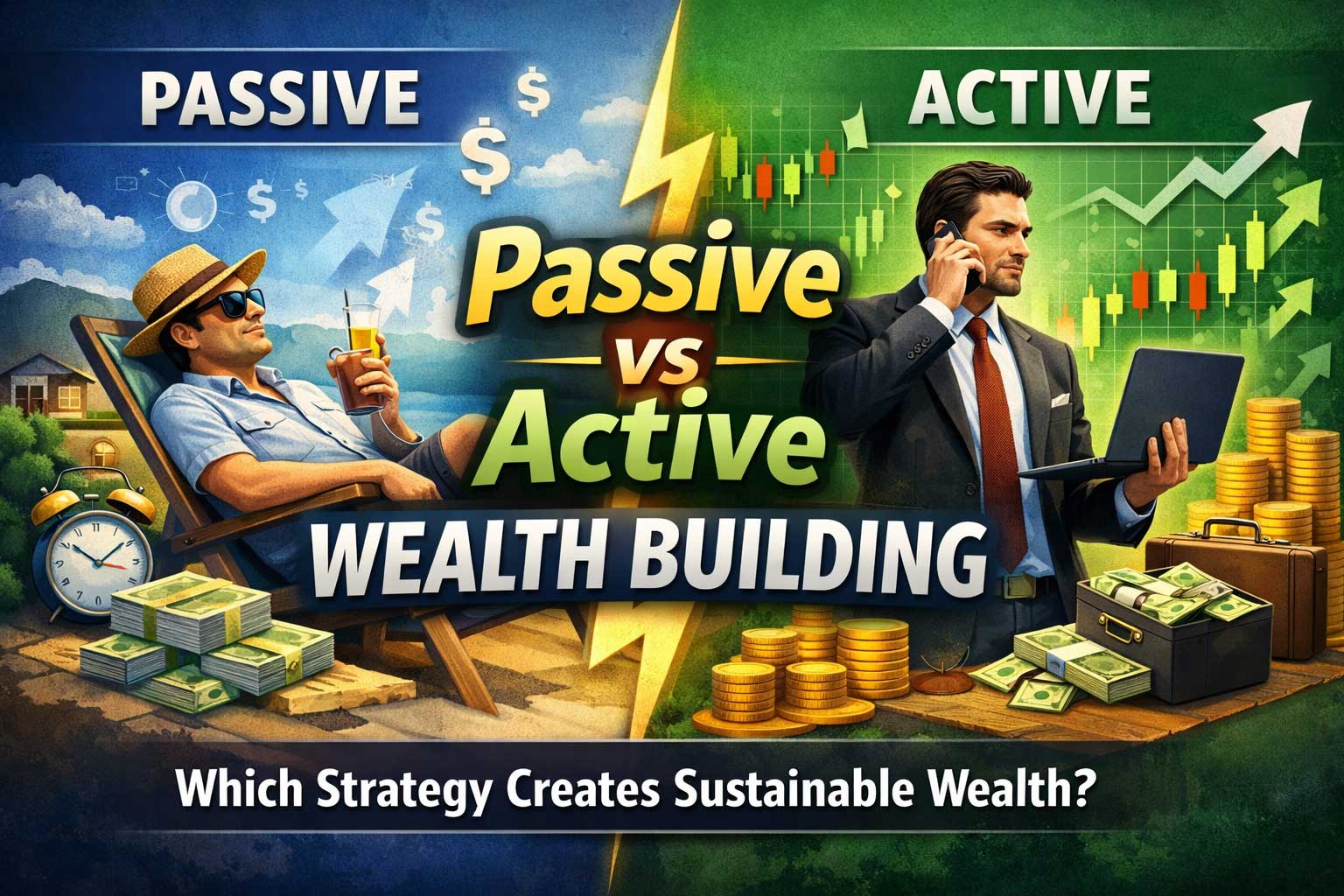
Wealth building is often described as a choice between two worlds: the world where money works for you (passive wealth building) and the world where you work for money (active wealth building). In real life, those worlds overlap constantly. Most people begin by building wealth actively—earning an income, learning skills, launching projects, taking on responsibilities. Over time, the goal becomes converting some of that active effort into assets that can produce results without constant labor. That conversion—turning work into ownership—sits at the center of sustainable wealth.
But there’s a reason people argue about “passive vs active.” Each strategy comes with trade-offs that affect long-term outcomes: how much time you must invest, how much risk you carry, how scalable your results can be, and how resilient your money is when life changes. Sustainable wealth isn’t just about getting rich once. It’s about building a system that can keep you stable, flexible, and financially secure across decades, across market cycles, and across personal transitions like career changes, family responsibilities, health issues, and retirement.
This article breaks down passive and active wealth building in a practical, detailed way. You’ll learn what each strategy really means, how different income types behave, what creates sustainability, and how to choose a plan that fits your personality, income level, timeline, and risk tolerance. You’ll also see why the “best strategy” is rarely one side only—and how the strongest wealth builders combine active and passive approaches into a clear, repeatable system.
Understanding What “Wealth Building” Really Means
Before comparing passive and active strategies, it helps to define wealth building clearly.
Wealth is not the same as income. Income is money coming in during a period—weekly, monthly, yearly. Wealth is what you own after subtracting what you owe. Wealth is net worth: assets minus liabilities. A person can earn a high income and still build little wealth if spending is high, debt is heavy, or saving is inconsistent. Another person can earn a moderate income and build strong wealth over time by owning assets, controlling lifestyle inflation, and consistently investing.
Wealth building, then, is the process of consistently increasing net worth over time. It includes:
- Growing income and controlling expenses so you can invest surplus cash
- Acquiring assets that appreciate or produce cash flow
- Reducing liabilities that drain your resources
- Managing risks that could wipe out progress
- Creating a system that can continue even when motivation drops or life gets busy
Sustainable wealth means this process can keep working long-term without requiring extreme luck or perfect conditions. It must survive market downturns, job changes, and unexpected expenses. It must be strong enough to recover from mistakes and flexible enough to adjust when your goals change.
With that foundation, we can compare passive and active strategies not as “which is better,” but as “which is better for a specific person at a specific stage, and how do they combine for long-term sustainability.”
Defining Active Wealth Building
Active wealth building is any strategy where your results depend heavily on your direct time, labor, or decision-making. You actively create value and earn money primarily through action: working, selling, managing, creating, negotiating, and executing.
Common examples of active wealth building include:
- A salary, wages, commission-based work
- Freelancing, consulting, coaching, services
- Running a business that requires daily management
- Sales, real estate wholesaling, project-based income
- Skilled trades, medical work, law, engineering, tech roles
- Content creation that depends on ongoing production and engagement
Active wealth building has one primary advantage: speed and control. You can often increase earnings faster by gaining skills, changing jobs, negotiating compensation, increasing prices, expanding services, or improving business operations. Your effort can produce immediate results.
But active wealth building has a limitation: it’s often tied to your capacity. Your day has a finite number of hours. Your energy is limited. Life happens. Even if you love your work, the ability to scale purely by effort usually hits a ceiling.
Active wealth building is often the engine that funds passive wealth building. It’s how you generate investable surplus. For most people, active income is the starting line.
Defining Passive Wealth Building
Passive wealth building is any strategy where your money grows or produces income with minimal ongoing effort from you. Passive does not mean “no work.” It usually means you do work upfront—learning, setting up, investing, acquiring—and then maintain the system periodically rather than constantly.
Common examples of passive wealth building include:
- Investing in broad market index funds or diversified portfolios
- Dividends and interest income from investments
- Rental properties managed by systems or property managers
- Royalties from intellectual property (books, music, patents)
- Digital products (courses, templates, software) that sell repeatedly
- Businesses that run with strong management and processes
- Automated or semi-automated online assets
Passive wealth building’s main advantage is scalability and durability. Once you own assets, they can grow even when you’re sleeping, traveling, or focusing elsewhere. Passive strategies are often what provide long-term financial freedom and resilience.
But passive wealth building has limitations too. It often requires upfront capital, time, patience, and risk management. The results can be slower at the beginning. You usually have less direct control over short-term outcomes because markets move, tenants move, customers change, and economic cycles happen.
The real power comes when active income is used intentionally to acquire passive assets—creating a loop where your work today buys freedom tomorrow.
Active vs Passive: The Core Differences That Matter
It’s easy to make superficial comparisons like “active is hard” and “passive is easy.” That oversimplifies reality. The differences that matter for sustainable wealth can be grouped into eight categories:
- Time dependency
- Active: income depends on time and energy.
- Passive: income depends on assets and systems.
- Scalability
- Active: scales with skill and leverage, but often capped.
- Passive: can scale significantly once assets are built.
- Upfront requirements
- Active: often requires skills, training, and effort.
- Passive: often requires capital, patience, and planning.
- Risk profile
- Active: job loss risk, burnout risk, industry disruption.
- Passive: market risk, asset risk, inflation risk, management risk.
- Control
- Active: high control over actions, prices, negotiations.
- Passive: less control over external forces, but control over allocation and diversification.
- Cash flow timing
- Active: immediate or regular paychecks.
- Passive: may be delayed (growth first, income later).
- Tax dynamics
- Active: typically taxed at higher rates in many systems.
- Passive: may offer favorable tax treatment depending on jurisdiction and structure.
- Sustainability under life changes
- Active: vulnerable if you cannot work.
- Passive: more resilient if structured well.
Now we’ll take these differences deeper to understand which strategy creates sustainable wealth—and how to build a plan that lasts.
The Sustainability Test: What Makes Wealth “Sustainable”?
Sustainable wealth is wealth that can survive and grow through:
- Economic downturns and bear markets
- Inflation and rising living costs
- Personal disruptions (health, family, job change)
- Industry shifts and technological change
- Unexpected expenses and emergencies
- Psychological stress and decision fatigue
To pass the sustainability test, a wealth strategy must include:
1) Consistent surplus generation
You must regularly generate surplus cash or value beyond your expenses. Active income often provides this early.
2) Asset accumulation
You must convert surplus into assets—things that can grow or produce income. Passive strategies dominate here.
3) Risk management
You must protect the system from collapse. This includes diversification, emergency funds, insurance, and avoiding over-leverage.
4) Adaptability
The strategy must still work as your life changes. What works in your 20s may not fit your 40s.
5) Behavior compatibility
A strategy is only sustainable if you can stick with it. The “best” strategy on paper fails if it doesn’t match your temperament.
This framework highlights a key truth: active wealth building is often stronger at surplus generation, while passive wealth building is stronger at asset accumulation and long-term resilience. Sustainable wealth usually requires both.
Active Wealth Building: Strengths, Limits, and Best Use Cases
Strength 1: You can start with little or no capital
Many active paths let you begin without large investments. You may need training, effort, and time, but not necessarily significant money. You can earn income through skills or services quickly compared to building an investment portfolio from scratch.
Strength 2: You can increase income dramatically with skill growth
Active income responds to skill upgrades. Learn a valuable skill, solve harder problems, manage people, create results, and you can often earn more.
Examples of skill-driven income growth:
- Negotiating raises and promotions
- Switching to higher-paying industries
- Increasing freelance rates as expertise rises
- Building a service business with premium positioning
Strength 3: You have direct control over outcomes
You can make decisions daily: improve quality, build relationships, adjust marketing, expand offerings, reduce costs. Active wealth building rewards initiative.
Strength 4: It can be faster in early stages
For someone starting at zero, active wealth building is often the quickest path to stability. You can increase income long before passive assets have time to compound.
Now the limits:
Limit 1: Time and energy create a ceiling
Even with high pay, most active income depends on you showing up. The more your income relies on your constant effort, the more fragile it becomes when life changes.
Limit 2: Burnout risk is real
Many high earners eventually discover the hidden cost: stress, health problems, strained relationships, lack of time. If wealth building destroys your ability to enjoy life, it’s not sustainable.
Limit 3: Industry disruption can erase earning power
Skills can become obsolete. Industries change. If your income depends on a niche that declines, you may face a sudden drop.
Limit 4: Lifestyle inflation can trap high earners
Active wealth building is vulnerable to spending growth. When income rises, many people upgrade everything. Without discipline, a bigger paycheck becomes a bigger lifestyle instead of bigger wealth.
Best use cases for active wealth building
Active strategies are ideal when:
- You need to stabilize finances quickly
- You have limited capital but strong willingness to learn and work
- You enjoy building skills and taking action
- You are early in your wealth-building journey
- You want to generate surplus to fund passive assets
In other words: active wealth building is the most accessible starting point for most people, and the most powerful lever for increasing investable cash in the early and middle stages.
Passive Wealth Building: Strengths, Limits, and Best Use Cases
Strength 1: Compounding creates exponential growth
Passive investing is powerful because returns build on themselves. Compounding is not linear. In the early years it can feel slow; later it can feel like acceleration.
Sustainable wealth often depends on compounding because it works without constant effort and can continue across decades.
Strength 2: Time flexibility and resilience
Passive assets can produce results while you focus on other things. This matters when you have family obligations, health issues, or simply want more control over your time.
Strength 3: Scalability without personal exhaustion
Once you own scalable assets—like a diversified portfolio, a well-managed rental, or a business with systems—growth doesn’t require you to work proportionally harder.
Strength 4: It reduces dependence on a single income source
Passive wealth building diversifies your life. A job loss is less scary when you have assets.
Now the limits:
Limit 1: It often requires upfront capital or time
Many passive strategies need either money to invest or time to build the asset. Someone living paycheck to paycheck can’t rely solely on passive methods at the start.
Limit 2: It demands patience and emotional stability
Markets move up and down. Passive investors must tolerate temporary declines without panic. That requires discipline and a long-term mindset.
Limit 3: “Passive” can be misleading
Many “passive income” ideas are actually businesses that require management. Rental properties need maintenance. Digital products need updates. Even index investing requires occasional rebalancing and consistent contributions.
Limit 4: Bad risk management can wipe out years of progress
Passive strategies often involve risk: market risk, credit risk, interest rate risk, tenant risk, and leverage risk. Without risk controls, “passive” can turn into “painful.”
Best use cases for passive wealth building
Passive strategies are ideal when:
- You have surplus income and can invest consistently
- You want long-term wealth and financial independence
- You value time freedom and resilience
- You can commit to patience and discipline
- You want to reduce dependence on active work over time
In other words: passive wealth building is the foundation of long-term sustainable wealth for most people—once they have the ability to invest.
The Truth About “Passive Income” vs “Passive Wealth”
A critical distinction: passive wealth building doesn’t always mean passive income today.
Some assets are growth-focused rather than income-focused. For example:
- Growth investments may not pay cash now but can increase in value.
- Index funds may provide returns mostly through price appreciation rather than monthly income.
- A business can be worth more even if it reinvests profits rather than paying you distributions.
Many people chase passive income too early and sacrifice growth. They want cash flow now because it feels tangible and motivating, but they may miss out on compounding that grows net worth faster over time.
Sustainable wealth usually requires a sequence:
- Build active income and stability
- Invest in growth assets to build net worth
- Shift toward income assets when you want lifestyle support
If you focus only on income assets too early, you may limit long-term growth. If you focus only on growth and ignore cash flow needs, you might get forced to sell at bad times. Sustainability comes from balance and timing.
Strategy Comparison Through Real-Life Scenarios
To make this practical, let’s compare how active and passive strategies behave in real situations.
Scenario 1: You lose your job unexpectedly
- Active-heavy plan: income drops sharply; savings determine survival.
- Passive-supported plan: dividends, interest, rental income, or portfolio reserves can reduce panic and buy time.
Sustainability favors having passive assets and an emergency fund.
Scenario 2: Inflation raises your cost of living
- Active-heavy plan: you need raises or more hours; stress increases.
- Passive plan: assets may grow with inflation over time, though not always immediately.
Sustainability favors assets that historically have the potential to outpace inflation, plus active income growth.
Scenario 3: You have a health issue and can’t work as much
- Active-heavy plan: high vulnerability; income may collapse.
- Passive plan: assets continue operating; you can reduce activity without total collapse.
Sustainability favors passive ownership.
Scenario 4: You want to build wealth quickly in your 20s or 30s
- Active plan: fastest path to increase earning power and investable surplus.
- Passive plan: essential for compounding, but requires contributions.
Sustainability favors active income growth paired with consistent investing.
Scenario 5: You want financial independence later in life
- Active plan: difficult if it relies on constant work.
- Passive plan: designed for long-term independence.
Sustainability favors passive assets, but funded by active effort earlier.
The pattern is consistent: active wealth building accelerates early progress; passive wealth building creates long-term resilience and freedom.
The Four Wealth Engines: How Money Is Really Made
Sustainable wealth usually comes from a mix of these engines:
- Income engine (active)
Your ability to earn through work or business. - Margin engine (behavioral)
Your ability to keep surplus by controlling expenses. - Investment engine (passive)
Your ability to grow surplus through compounding. - Ownership engine (hybrid)
Your ability to own scalable assets like businesses, real estate, or intellectual property.
Most people focus too much on one engine and neglect the others. Sustainable wealth comes from building all four.
If you earn a lot but spend it all, your margin engine is broken. If you save but never invest, your investment engine is missing. If you invest but never grow income, contributions may be too small. If you do everything yourself with no ownership, you never build leverage.
Passive vs active is not a simple either-or. It’s a question of which engines you’re strengthening at your current stage.
The “Active-to-Passive Conversion” Model
Here is one of the most practical ways to think about sustainable wealth:
- Use active income to create surplus.
- Convert surplus into passive assets.
- Reinforce the active income engine by improving skills.
- Repeat until passive assets can cover your desired lifestyle.
This model avoids common traps:
- Relying on passive assets too early when you have no surplus
- Chasing risky “passive income hacks” instead of building a stable base
- Staying stuck in active income forever and never building ownership
The conversion model is how many financially independent people actually build wealth.
The Biggest Mistakes People Make When Choosing a Strategy
Mistake 1: Choosing “passive” as an excuse to avoid effort
Passive wealth building still requires discipline, learning, and consistency. If you skip the work of building active income and surplus, passive investing becomes too small to matter.
Mistake 2: Staying “active” because it feels safer
Some people earn well but never invest seriously. They trust their job more than markets. But jobs are not guaranteed, and time is limited. Without investing, they can work for decades and still remain dependent on a paycheck.
Mistake 3: Over-leveraging passive assets too early
People sometimes buy rental properties with little buffer, or invest aggressively without emergency reserves. When a crisis hits, they get forced to sell or take on costly debt.
Mistake 4: Ignoring lifestyle inflation
If your spending rises as fast as your income, both strategies fail. Sustainable wealth depends on the gap between what you earn and what you spend.
Mistake 5: Treating one strategy as morally superior
Some people view passive investing as “smart” and active work as “trapped.” Others view active hustling as “real work” and passive investing as “lazy.” Both mindsets create blind spots. Sustainable wealth is practical, not ideological.
Which Strategy Creates Sustainable Wealth?
If forced to choose one strategy that is most consistently tied to long-term sustainability across broad populations, passive wealth building—specifically owning diversified assets that can compound—has the strongest long-term track record as a concept. The reason is simple: it is not limited by your time and physical capacity, and it can continue through life changes.
However, that does not mean passive wealth building works alone. Passive wealth building requires fuel, and the fuel is usually active income.
So the most accurate answer is:
The strategy that creates sustainable wealth is an active-to-passive system: build strong active income and margins early, then convert surplus into diversified passive assets, gradually shifting your life dependence from labor to ownership.
Sustainability is created by the combination: active income for acceleration and adaptability, passive assets for resilience and freedom.
How to Choose the Right Mix for Your Situation
Your best strategy depends on five personal factors:
1) Starting point: income, savings, debt
- If you have little surplus, prioritize active income growth and debt control.
- If you have stable surplus, prioritize consistent investing.
2) Timeline: how soon you need results
- Short-term goals favor active moves (career upgrades, side income).
- Long-term goals favor passive compounding.
3) Risk tolerance and emotional stability
- If market swings cause panic, you need a plan that you can stick to—possibly slower, more conservative, and automated.
4) Skill set and interests
- If you enjoy entrepreneurship, active business ownership can become a hybrid that turns into semi-passive later.
- If you prefer simplicity, systematic investing may be your best foundation.
5) Time availability and life responsibilities
- Busy seasons of life may require more passive focus.
- High-energy seasons may be ideal for aggressive active growth.
Sustainable wealth means choosing a mix you can maintain for years, not weeks.
Stage-Based Wealth Strategy: What to Focus on at Each Stage
Stage 1: Stabilize (build safety and control)
Goal: stop financial leaks and create breathing room.
Focus areas:
- Build a basic emergency fund
- Pay down high-interest debt
- Track spending and set a realistic budget
- Increase active income where possible
- Avoid major lifestyle inflation
At this stage, passive investing might be small, but it’s still valuable to start habits—especially if you can automate small contributions.
Stage 2: Accelerate (maximize surplus)
Goal: increase the gap between earnings and spending.
Focus areas:
- Upgrade skills that increase income
- Negotiate pay, switch roles, or expand side income
- Build systems to keep expenses controlled
- Start consistent investing into diversified assets
- Build credit and financial stability for future opportunities
This stage is where active wealth building shines. Passive investing becomes meaningful through consistent contributions.
Stage 3: Convert (turn income into ownership)
Goal: shift from labor-based wealth to asset-based wealth.
Focus areas:
- Increase investment rate
- Diversify asset classes
- Consider real estate, business ownership, or scalable digital assets if appropriate
- Build tax efficiency and risk controls
- Strengthen automation and long-term discipline
This stage is where passive wealth building becomes a dominant driver.
Stage 4: Sustain (protect, simplify, and live)
Goal: make wealth resilient and usable.
Focus areas:
- Reduce risk concentration
- Maintain diversified passive income streams
- Plan for healthcare, family needs, and long-term obligations
- Shift from growth to income as needed
- Build a lifestyle that is supported by assets, not constant labor
Sustainable wealth is not just “more.” It’s stable. It lasts.
Key Passive Wealth Building Approaches Explained
1) Broad market investing and index-style portfolios
This approach focuses on diversified exposure to businesses and the economy rather than trying to pick winners.
Why it supports sustainability:
- Diversification reduces single-company risk
- Long-term compounding rewards patience
- Low maintenance compared to active trading
- Can be automated and consistent
The sustainability challenge:
- Requires emotional discipline during downturns
- Requires long time horizon for best results
- Requires consistent contributions
2) Dividend and income investing
This focuses on assets that pay cash flow.
Why it supports sustainability:
- Provides income that can support lifestyle
- Can reduce the need to sell assets during downturns
The sustainability challenge:
- Income assets can still decline in value
- Focusing too early on income can limit growth
- Requires diversification to avoid yield traps
3) Real estate for cash flow and appreciation
Rental property can combine income and long-term equity growth.
Why it supports sustainability:
- Can generate cash flow
- Can hedge inflation in certain scenarios
- Offers tangible asset ownership
- Can use leverage carefully to accelerate wealth
The sustainability challenge:
- Requires management or paid management
- Has concentrated risk per property
- Repairs, vacancies, and legal issues can occur
- Over-leverage can destroy sustainability
4) Semi-passive businesses and systems
A business can be active at first and become more passive through systems, teams, and processes.
Why it supports sustainability:
- Ownership can create large wealth
- Scalability can exceed wages
- You can sell the business as an asset
The sustainability challenge:
- Many businesses never become passive
- Requires leadership and operations skill
- Higher failure risk than diversified investing
5) Digital assets and intellectual property
Digital products can scale without physical inventory.
Why it supports sustainability:
- High scalability
- Low marginal cost per additional sale
- Can become a long-term asset with updates
The sustainability challenge:
- Often requires marketing and competition management
- Revenue can be inconsistent
- Needs maintenance and refresh cycles
The key is not which passive approach is “best,” but which one fits your stage, skills, and risk tolerance.
Key Active Wealth Building Approaches Explained
1) Career growth and income optimization
This includes skill development, promotions, job changes, negotiation, and specialization.
Why it supports sustainability:
- Higher income increases investing capacity
- Skills are portable and resilient
- Can be planned and measured
The sustainability challenge:
- Depends on your ability to work
- Vulnerable to burnout if not balanced
2) High-value freelancing and consulting
Selling specialized expertise can dramatically increase income.
Why it supports sustainability:
- Control over rates and clients
- Can become a business later
- Builds network and reputation
The sustainability challenge:
- Income volatility
- Requires sales and relationship management
- Can become time-trapped without systems
3) Entrepreneurship and active business building
Building a company can be a major wealth engine.
Why it supports sustainability:
- Ownership creates leverage
- Potential for outsized returns
- Can turn into a sellable asset
The sustainability challenge:
- Higher risk and stress
- May require long work hours
- Requires strong financial discipline to avoid reinvesting everything without returns
4) Active investing (trading, picking, speculation)
This is high effort, high skill, and often high risk.
Why it can work:
- Skilled individuals may generate returns
Why it often fails sustainability:
- Emotional stress and volatility
- Requires constant attention
- Many people underperform due to behavior and costs
If sustainability is the goal, active investing should usually be a small portion unless you have proven expertise, strict risk management, and the emotional discipline to handle losses.
The Wealth Triangle: Time, Money, and Risk
Every wealth strategy is a trade between time, money, and risk.
- If you have little money, you must invest more time (active work) or take more risk (which is dangerous).
- If you have little time, you need money to invest (passive capital) or you need leverage and systems.
- If you want low risk, you must accept slower growth and prioritize diversification and stability.
Sustainable wealth means balancing this triangle rather than chasing maximum growth at any cost.
Building a Sustainable Plan: The Hybrid Strategy Blueprint
Here is a practical blueprint that combines active and passive wealth building:
Step 1: Build a strong active income foundation
- Choose an income path with growth potential
- Invest in skills that increase earning power
- Track performance and negotiate compensation
Step 2: Build margin (surplus) intentionally
- Use a budget that aligns with your goals
- Automate savings and bills
- Avoid lifestyle inflation after income increases
Step 3: Build safety buffers
- Emergency fund
- Insurance and risk protection
- Conservative debt management
Step 4: Automate passive investing
- Contribute consistently
- Diversify broadly
- Rebalance periodically
- Stay long-term and avoid emotional decisions
Step 5: Add ownership-based assets when ready
- Real estate if you have buffers and a plan
- Business ownership if you can build systems
- Digital assets if you can maintain quality and marketing
Step 6: Reduce dependence on labor
- Increase passive asset base
- Build multiple streams and diversify
- Create flexibility in work arrangements
This blueprint is sustainable because it creates progress through consistent behavior, not just bursts of motivation.
How to Know If You’re Too “Active” or Too “Passive”
Signs you’re too active-heavy
- Your finances collapse if you stop working for a few months
- You feel constant pressure to earn more to maintain lifestyle
- You have little time freedom
- You’re building income but not building assets
- You’re vulnerable to burnout
Solutions:
- Increase investing rate
- Automate passive contributions
- Build systems and delegation
- Reduce lifestyle costs to create margin
Signs you’re too passive-heavy (too early)
- You’re investing tiny amounts while ignoring income growth
- You avoid skill development because investing feels “enough”
- You chase passive income schemes without a stable base
- You lack emergency reserves but take investment risks
Solutions:
- Focus on active income growth
- Build surplus first
- Learn fundamentals of budgeting and stability
- Delay complex passive plays until you have buffers
Sustainable wealth is usually a balance where active effort builds surplus, and passive assets accumulate steadily.
The Psychology of Sustainable Wealth: Why Behavior Beats Strategy
The best wealth strategy is the one you can follow consistently for years. Behavior is more powerful than cleverness.
Sustainable wealth behavior includes:
- Living below your means consistently
- Increasing income without increasing lifestyle equally
- Investing automatically and staying consistent
- Avoiding panic selling and emotional decisions
- Learning continuously without chasing hype
- Staying patient during slow periods
- Building a long-term identity as an owner and investor
Many people fail not because they chose the wrong strategy, but because they couldn’t stay consistent. They started strong, then stopped. They invested, then pulled out during a downturn. They earned more, then upgraded lifestyle. Sustainable wealth is built with steady repetition.
A Practical Decision Guide: Which Strategy Should You Emphasize?
You should emphasize active wealth building right now if:
- You have little surplus
- You’re carrying high-interest debt
- Your income is unstable or too low
- You’re early in your career and can grow skills fast
- You need faster financial stability
You should emphasize passive wealth building right now if:
- You have consistent surplus after expenses
- You have emergency reserves
- You want long-term financial independence
- You can commit to patience
- You want resilience against job loss or life disruption
You should emphasize a hybrid approach if:
- You want both growth and resilience
- You want faster progress without burning out
- You want to convert today’s work into long-term assets
- You want a plan that adapts as your life changes
For most people, the hybrid approach is the most sustainable because it harnesses active effort for fuel and passive ownership for freedom.
Example Wealth Plans Based on Different Priorities
Plan A: Stability-first (low stress, high sustainability)
- Focus on steady career growth
- Build a strong emergency fund
- Pay down high-interest debt
- Invest consistently into diversified assets
- Avoid risky leverage
This plan may not be the fastest, but it’s highly sustainable.
Plan B: Acceleration-first (aggressive growth, controlled risk)
- Prioritize income growth rapidly (skills, career switches, business)
- Keep spending controlled
- Invest a high percentage of income
- Add ownership assets when buffers are strong
- Use leverage carefully, not emotionally
This plan can build wealth quickly if behavior stays disciplined.
Plan C: Time-freedom-first (build passive base early)
- Maintain stable income
- Keep lifestyle modest
- Invest heavily into long-term growth assets
- Build semi-passive assets with manageable maintenance
- Shift work gradually to flexible arrangements
This plan is ideal if time freedom is a top goal.
The best plan is the one that matches your priorities and personality.
Final Verdict: The Sustainable Wealth Answer
If you measure sustainability by resilience, long-term growth, flexibility, and the ability to maintain wealth through changing life conditions, passive wealth building is the strongest foundation because ownership and compounding are not limited by your daily labor.
But passive wealth building rarely starts on its own. It needs fuel, and that fuel is active wealth building—income, skill, and surplus.
So the strategy that creates sustainable wealth is not passive or active alone. It is a system that starts active, becomes increasingly passive, and stays balanced through diversification and risk management.
Build income. Protect margin. Convert surplus into assets. Repeat.
That is the sustainable wealth formula.
FAQs: Passive vs Active Wealth Building
Is passive wealth building truly “hands-off”?
Rarely. The most passive form is automated investing into diversified funds and holding long-term. Other passive streams like rentals or digital products still require maintenance, decisions, and periodic work.
Can active wealth building create financial independence by itself?
It can if income is extremely high and expenses are low, but independence still typically depends on investing and ownership. Otherwise, you remain dependent on your ability to work.
What if I don’t earn much—should I still invest?
If you can cover essentials and maintain a small emergency cushion, consistent investing—even small amounts—helps build habits and compounding over time. But if you’re struggling to survive, focusing on income growth and stability comes first.
Which strategy is safer?
Both carry risks. Active income risk includes job loss and burnout. Passive risk includes market volatility and asset-specific risks. The safest approach is diversification across income sources and asset types.
What’s the best way to start if I feel overwhelmed?
Start with three steps: track spending, build a small emergency fund, and automate a modest investing contribution. Then focus on skill growth to increase income.